


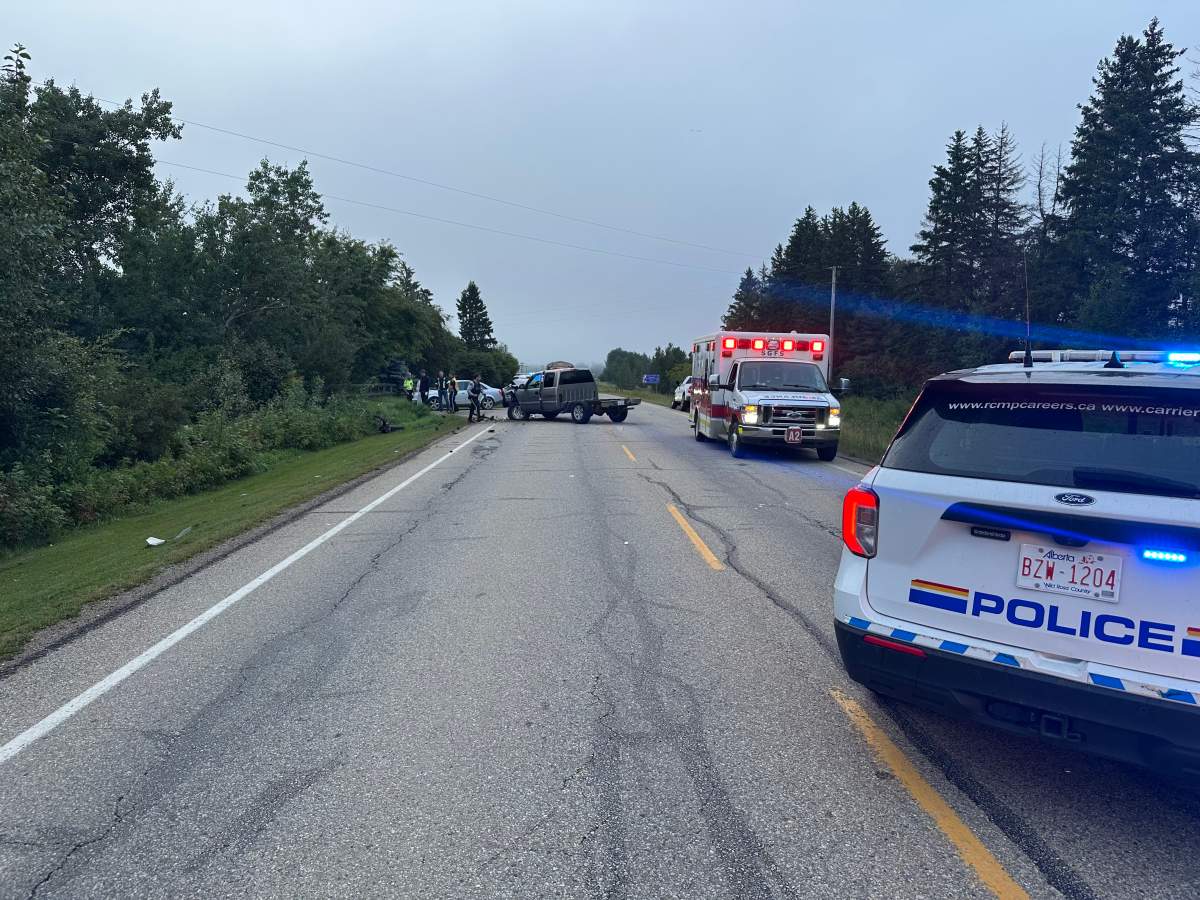
Driving habits in Alberta have taken a turn for the worse. RCMP say based on the data so far in 2026, the province is on track to record the highest number of traffic fatalities in a decade.

“We’ve had good years and we’ve had bad years in the last 10 years,” said RCMP Sgt. Darrin Turnbull, a nearly three-decade veteran of the force.
Alberta RCMP recorded 286 traffic deaths in 2015. The lowest since then was in 2019, when 210 people died.
“But how sad is it for me to say that we’ve had good years, when a good year is 210 people dying on Alberta highways? That’s way too many — and that’s a good year! We need to have those numbers come down.”
“We’re begging Albertans to please drive safe.”
Between Jan. 1 and Aug. 31, RCMP recorded 192 traffic deaths on the roads it patrols across Alberta, compared with 144 during the same period in 2025.
June has been the only month so far in 2026 with fewer fatalities than normal, police said — every other month has exceeded the four-year average.
Traffic collisions increase in the fall and winter due to shorter daylight hours, slippery roads, and peak wildlife mating season leading to more crashes with deer and other large animals.
“Typically in months of September, October, November, December, Alberta RCMP’s average is 82 people who die on our highways. If we keep that average up, or that pace up for this next year, we’re gonna be at a 10-year high.”

Police said based on historical trends, if the fatal collision pattern continues, 2026 could end with 274 deaths.
“Behind these numbers are the friends, families, loved ones, neighbours, co-workers who knew these people who died on our highways,” Turnbull said.
Turnbull has been a Mountie for 29 years and has delivered his fair share of bad news to those loved ones.
“Having to knock on the door on Saturday at two o’clock in the morning, just to say somebody’s not coming home. It’s hard on us. It’s hard on the first responders: Fire, EMS, the towing companies. We all see the devastation.”
The majority of fatal collisions are preventable, Turnbull said.

Get daily National news
“When a crash is preventable, it means the driver can be doing something else — whether that be driving sober, whether that’d be not driving distracted or obeying the rule of the road. All of those things, if the drivers were doing that at the time, those crashes would not have happened.”
It isn’t just fatal crashes that have gone up either: compared to 2022, RCMP said the number of injury collisions has risen by 24 per cent.
While the data released Tuesday by RCMP only applies to roads it patrols, so far this year in Calgary there have been 26 fatal crashes. In Edmonton, police have recorded 14 and in Lethbridge police told Global News that southern Alberta city has had one.

Turnbull said it isn’t one single thing driving the rise in both deaths, injuries and risky behaviour.
“RCMP has noticed the speeds of vehicles increasing. We’ve noticed more distracted drivers; we’ve noticed more people not wearing their seatbelts. All of these things,” he said.
“Please, slow down. Wear your seatbelts, drive sober, and at intersections, make sure you stop at those stop signs and at those red lights.”
Excessive speeding is also up.
From January to August, officers issued 570 tickets to drivers going at least 50 km/h over the speed limit — the highest number recorded since 2022.
“On a standard Alberta highway of 100 km per hour speed limit, they’re going 150 or more over the speed limit,” Turnbull said. “These speeds are what we see that result in these terrible, tragic, fatal car crashes.”
The number of vehicles caught racing or going extreme speeds is alarming, police say.
“We have examples daily that come into Alberta RCMP where vehicles are travelling 200, 210, 220 kilometres per hour. Double the speed limits.
“It’s a disaster waiting to happen.”
Drunk and high driving continues to be a problem. Since 2022, drivers caught impaired by drugs or alcohol have increased by 15 per cent.
A few months ago, RCMP ran a checkstop at a rural location south of Calgary and almost all of the drivers tested had alcohol in their system.
“We found that 45 out of 50 — so 90 per cent of the vehicles coming through — had been consuming alcohol.”


Two of those vehicles received driving suspensions for being impaired by alcohol, Turnbull said, while the remainder didn’t blow over but still had measurable amounts of booze in their system.
“Only five drivers who came through that checkstop had not been drinking.”

More drivers are being caught distracted as well: RCMP said since 2022, the use of electronic handheld devices or drivers engaging in distracting behaviour has increased by 52 per cent, while driving without due care or attention is up 14 per cent.
“The decisions you make while you’re driving a motor vehicle can have life-altering decisions for you and for the people in your vehicle and the people around you. So a simple little mistake of checking a text message or whatever it might be that distracts you from your driving can end somebody’s life,” Turnbull said.
“Just drive the vehicle, leave the phone alone.”
The plea from law enforcement comes as Alberta Transportation is testing a higher speed limit on the province’s busiest highway.
A 44-kilometre section of the QEII south of Leduc has been raised from 110 to 120 km/h, on a road that already regularly sees most traffic flowing closer to 130-140 km/h.
RCMP wouldn’t say whether the speed increase pilot project was a good or bad move.
“We don’t make the law, we enforce the laws,” Turnbull said, noting speed limits are determined based on expertise from specialists like highway engineers. “We are going to enforce the speed limits of whatever the speed limits are, wherever they are, to make sure that Albertans are safe.”

Turnbull said collision reports are forwarded on to Alberta Transportation.
“Our job is to provide that information and that data so that they are aware of the crashes — how many crashes are happening, where they’re happening.”
This year, Alberta increased the fines for serious offences like careless driving, excessive speeding, stunting and racing by 50 per cent, with most other traffic penalties rising by 30 per cent.
Police can’t be everywhere all at once and Turnbull is reminding Albertans they can call in to report bad driving when they see it.
“Let us know the description of the vehicle, direction of travel, description of a driver, and we will do our best to have an officer attempt to locate that vehicle and intercept it.”
| ALBERTA RCMP TRAFFIC FATALITIES | |
| YEAR | TOTAL |
| 2015 | 286 |
| 2016 | 237 |
| 2017 | 248 |
| 2018 | 250 |
| 2019 | 210 |
| 2020 | 223 |
| 2021 | 253 |
| 2022 | 214 |
| 2023 | 244 |
| 2024 | 243 |
| 2025 | 216 |
| 2026 | 192 (as of August 31) |


Comments
Comments closed.
Due to the sensitive and/or legal subject matter of some of the content on globalnews.ca, we reserve the ability to disable comments from time to time.
Please see our Commenting Policy for more.