

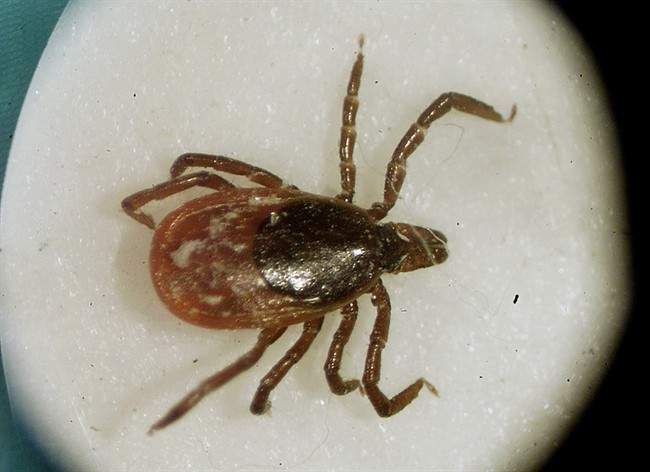
TORONTO – The University of Guelph is opening a research lab dedicated to improving testing and treatment for Lyme disease, a tick-borne bacteria that is increasingly affecting Canadians across the country.

The Ontario university’s lab is being set up with a $1.4-million grant from the G. Magnotta Foundation for Vector-Borne Diseases, named for Magnotta Winery co-founder Gabe Magnotta.
READ MORE: Federal government to pour $4 million into first-ever Lyme disease framework — here’s why

Get weekly health news
Magnotta died in 2009 from complications of Lyme disease. His wife and business partner Rossana Magnotta created the non-profit foundation in 2012.
Lyme disease is caused by the bacteria Borrelia, which is transmitted through the bites of infected ticks.
Infected individuals initially experience flu-like symptoms. But left untreated, the disease can affect the skin, internal organs, musculoskeletal system, eyesight and hearing.
- ‘Maddening’: Family of Winnipeg woman who died after lengthy hospital wait calls for change
- Saskatchewan health-care workers vote 99% in favour of job action: CUPE
- Patients face challenges when seeking medical care not offered in Nova Scotia: audit
- Nova Scotia aims to reduce mammogram wait times, enhance women’s health care
-
![]() Reasearchers watch closely as the latest strain of the flu virus makes its way to Canada for the upcoming respiratory virus season
Reasearchers watch closely as the latest strain of the flu virus makes its way to Canada for the upcoming respiratory virus season -
![]() Nova Scotia unveils initatives to improve women’s health care
Nova Scotia unveils initatives to improve women’s health care -
![]() EPA shortage leaves N.S. student attending school only part time
EPA shortage leaves N.S. student attending school only part time -
![]() Endometrial cancer awareness campaign kicks off, doctors say more education needed
Endometrial cancer awareness campaign kicks off, doctors say more education needed


READ MORE: More ticks means an increase of Lyme disease across Canada — thanks to climate change
Lyme is often misdiagnosed, as its symptoms can mimic other neurological disorders such as multiple sclerosis, Lou Gehrig’s disease, Alzheimer’s and Parkinson’s.
“Lyme disease is increasingly recognized as a substantial threat across the country, and there is a profound need for high-quality science that can improve the lives of afflicted Canadians,” said Melanie Wills, a research associate in the school’s molecular and cellular biology department, who will head the new lab.


Comments
Want to discuss? Please read our Commenting Policy first.