

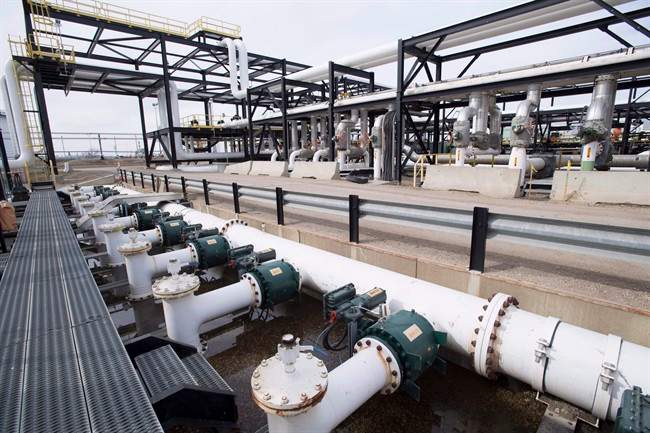
The Federal Court of Appeal has set aside a decision by the minister of Indian affairs that allowed the expansion of the Trans Mountain oil pipeline through the Coldwater Indian Reserve near Merritt, B.C.

The band expressed its concerns for plans to increase the pipelines capacity by twining it, and asked that the government modernize a 1952 agreement to allow for better compensation and environmental practices.
The Coldwater nation was paid $1,292 when the existing Trans Mountain pipeline was constructed through its reserve over 60 years ago.

Get weekly money news
In a split decision, the three-judge panel ruled the federal minister failed to assess the impacts of the easement on the Coldwater band and that it has a continuing duty to protect the band’s interests on its reserve from an exploitive bargain.
READ MORE: Trans Mountain pipeline project facing new legal challenges from First Nations
The court has ordered that the federal government redetermine the approval with consideration of the court decision in mind. Coldwater Chief Lee Spahan says in a news release the band is happy the court recognized the importance of its land.
- TC Energy urges co-operation on growing natural gas network to meet ‘generational’ demand
- AI stocks drop as tech companies call to slow down development for safety
- Central Alberta carbon capture hub on track to be largest in Canada
- Enbridge makes US$2.55B acquisition of pipeline, storage systems in U.S. midwest


Watch below: Some videos from Global News’ ongoing coverage of the Trans Mountain pipeline expansion project and its legal and political hurdles.

-
![]() Construction begins on Line 3 pipeline project as Trans Mountain faces hurdles
Construction begins on Line 3 pipeline project as Trans Mountain faces hurdles -
![]() BC NDP joins legal challenge against Trans Mountain pipeline project
BC NDP joins legal challenge against Trans Mountain pipeline project -
![]() Will there be more measures coming against the Trans Mountain pipeline?
Will there be more measures coming against the Trans Mountain pipeline? -
![]() Will the province consider legal action to stop the Trans Mountain pipeline?
Will the province consider legal action to stop the Trans Mountain pipeline? -
![]() First Nations legal issues and provincial abilities to be used against Trans Mountain: Horgan
First Nations legal issues and provincial abilities to be used against Trans Mountain: Horgan -
![]() Opposition in B.C. has right to use courts to oppose Trans Mountain: Carr
Opposition in B.C. has right to use courts to oppose Trans Mountain: Carr -
![]() NDP’s Cullen says B.C. accepting huge risk on Trans Mountain pipeline
NDP’s Cullen says B.C. accepting huge risk on Trans Mountain pipeline -
![]() Trans Mountain pipeline reveals need to develop better pipeline strategy: Elizabeth May
Trans Mountain pipeline reveals need to develop better pipeline strategy: Elizabeth May -
![]() Alberta premier stresses commitment to Trans Mountain
Alberta premier stresses commitment to Trans Mountain -
![]() Rachel Notley says Trans Mountain opponents can’t hold economy hostage
Rachel Notley says Trans Mountain opponents can’t hold economy hostage -
![]() Evraz to provide supply 800 kilometres of pipeline for Trans Mountain Pipeline expansion needs
Evraz to provide supply 800 kilometres of pipeline for Trans Mountain Pipeline expansion needs -
![]() BIV: Business community reacts to Trans Mountain pipeline approval
BIV: Business community reacts to Trans Mountain pipeline approval -
![]() BIV: Business community reacts to Trans Mountain pipeline approval
BIV: Business community reacts to Trans Mountain pipeline approval -
![]() Trans Mountain pipeline expansion approved in B.C.
Trans Mountain pipeline expansion approved in B.C. -
![]() Province gives Trans Mountain expansion environmental approval
Province gives Trans Mountain expansion environmental approval -
![]() Premier Notley speaks about Jane Fonda visit, Trans Mountain approval
Premier Notley speaks about Jane Fonda visit, Trans Mountain approval -
![]() Premier Christy Clark’s message to those opposed to Trans Mountain pipeline
Premier Christy Clark’s message to those opposed to Trans Mountain pipeline -
![]() How the Trans Mountain pipeline met environmental approval
How the Trans Mountain pipeline met environmental approval -
![]() Presser: B.C. grants environmental assessment approval for Trans Mountain pipeline
Presser: B.C. grants environmental assessment approval for Trans Mountain pipeline -
![]() Federal government approves Kinder Morgan Trans Mountain pipeline
Federal government approves Kinder Morgan Trans Mountain pipeline




Comments
Want to discuss? Please read our Commenting Policy first.