


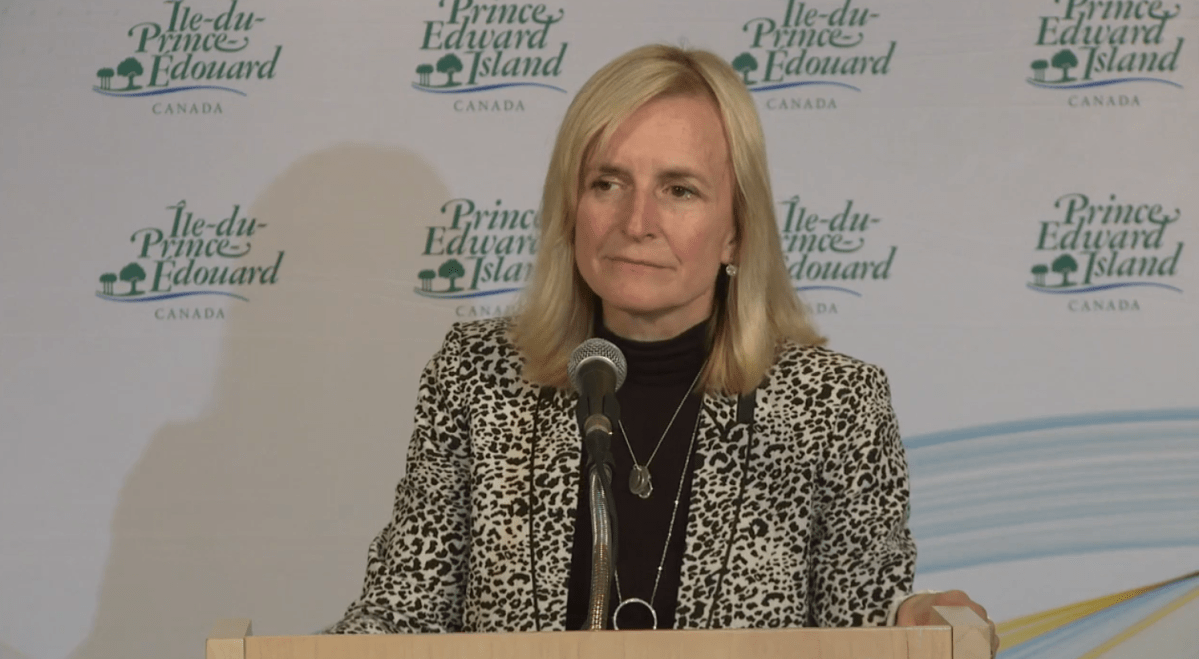
Prince Edward Island’s top doctor has announced four new cases of COVID-19 in the province, bringing the total to nine.

Dr. Heather Morrison, P.E.I.’s chief health officer, says she received confirmation of the cases Thursday afternoon.
All four cases are men between the ages of 55 and 70 who have recently returned from travelling outside of Canada.
Two of the individuals were in Europe, one travelled to the United States, one to the Caribbean.

Get weekly health news
READ MORE: 1 of 5 COVID-19 cases on P.E.I. considered recovered
Two of the cases are residents of Queens County, the other two of Prince County.
Morrison says the four men are self-isolating at home and doing well.
“I literally just got off the phone with them and public health nursing will be initiating contact follow up with them tonight,” said Morrison at a press conference Thursday afternoon,
The contact tracing process will reveal flight information, which Morrison says will be made available online.

- Nova Scotia aims to reduce mammogram wait times, enhance women’s health care
- Anthrax outbreak kills more than 50 animals, infects 12 people in Zambia
- Childhood Cancer Canada calls for $15M from feds as demand rises
- ‘E-dirt bikes are not toys’: E.R. doc fears more injuries after 2 kids hit in Edmonton


At an update earlier Thursday afternoon, Morrison said one of the P.E.I. residents who had tested positive for COVID-19 is now considered recovered.
She says that moving forward, less information may be given on confirmed positive cases on the Island to preserve for privacy reasons.
Questions about COVID-19? Here are some things you need to know:
Health officials caution against all international travel. Returning travellers are legally obligated to self-isolate for 14 days, beginning March 26, in case they develop symptoms and to prevent spreading the virus to others. Some provinces and territories have also implemented additional recommendations or enforcement measures to ensure those returning to the area self-isolate.
Symptoms can include fever, cough and difficulty breathing — very similar to a cold or flu. Some people can develop a more severe illness. People most at risk of this include older adults and people with severe chronic medical conditions like heart, lung or kidney disease. If you develop symptoms, contact public health authorities.
To prevent the virus from spreading, experts recommend frequent handwashing and coughing into your sleeve. They also recommend minimizing contact with others, staying home as much as possible and maintaining a distance of two metres from other people if you go out.
For full COVID-19 coverage from Global News, click here.


Comments
Want to discuss? Please read our Commenting Policy first.