





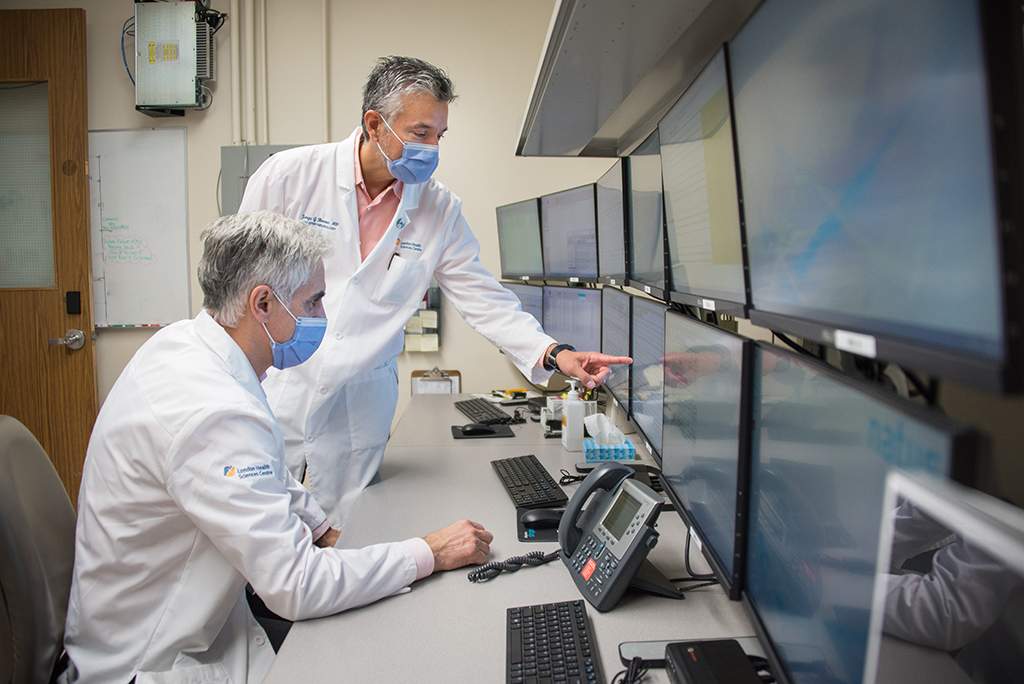
London Health Sciences Centre is welcoming the addition of new electroencephalogram (EEG) machines to its epilepsy monitoring unit, which it says has helped advance research and diagnosis of the neurological disorder.

LHSC says the 13 state-of-the-art portable EEG machines have increased the amount of data collected from patients in the unit, and provides faster reporting and better, high-quality images, officials said in a media release.
Read more: ‘Very difficult flu season’ expected, head of London, Ont. Children’s Hospital emerg says
The new EEG machines, which measure electrical activity in the brain using electrodes on the patient’s scalp, allows data to be collected wherever the patient may be within the hospital, resulting in more consistent data, according to LHSC.

Get weekly health news
“What it does is — and this is an update to the equipment that we’ve had already, but this is a more advanced version of it — this equipment allows us to monitor a patient’s seizures in real-time while they’re in the hospital,” said Dr. David Steven, chair/chief of clinical neurological sciences at LHSC.
Many patients with epilepsy, he says, can be treated with medication, however, others cannot. For them, doctors need to determine where their seizures are coming from and whether surgery is a potential option, he said.
“In order to do that, we bring them into this unit and we’re able to film the seizures and record them at the same time with these high definition cameras and high fidelity recording equipment to be able to see if we can tell where the seizures are coming from, and help them and help us come up with a more firm diagnosis for them,” he said.
- Nova Scotia aims to reduce mammogram wait times, enhance women’s health care
- Anthrax outbreak kills more than 50 animals, infects 12 people in Zambia
- Childhood Cancer Canada calls for $15M from feds as demand rises
- ‘E-dirt bikes are not toys’: E.R. doc fears more injuries after 2 kids hit in Edmonton


“This technology allows us to to fine tune … a bit better to find out which candidates we think would benefit from surgery and potentially cure their epilepsy.”
In addition, the equipment also helps doctors identify patients who may benefit from other types of treatment, including treatments that are just now becoming available that, while not curative, would still be an improvement over medication, he said.
The new machines were acquired with a $2 million investment, according to LHSC.
LHSC’s epilepsy monitoring unit first opened in 1987, and has assessed and provided care to more than 10,000 patients, according to the organization.
— With files from Mike Stubbs


Comments
Want to discuss? Please read our Commenting Policy first.