



From destructive hail to excessive rain, drought and extreme heat, severe weather is taking a toll on pumpkin farms across Canada as growers prepare for the busy fall season.

Farmers in several provinces say unusually intense or poorly timed weather has damaged crops, accelerated growing seasons and made it increasingly difficult to predict what their fields will look like by Thanksgiving and Halloween.
In Ontario, Jordan Mackay saw firsthand how quickly a promising growing season could change.
“We lost our pumpkins, tomatoes, lots of strawberries,” Mackay told Global News, whose family is also involved with Pingle’s Farm Market and Nature’s Bounty Farm.
On Aug. 8, a severe hailstorm tore through his family’s Willowtree Farm in Port Perry, Ont., destroying more than 300 acres of crops in roughly 10 minutes.
“We’ve had hail before, but not wiping out all the crops to that devastating effect.”
The family’s other farms escaped the hail, but another weather problem soon emerged.
After what Mackay described as a good start to the growing season, heavy rainfall through August began taking a toll on pumpkins at the family’s Oshawa-area farm.
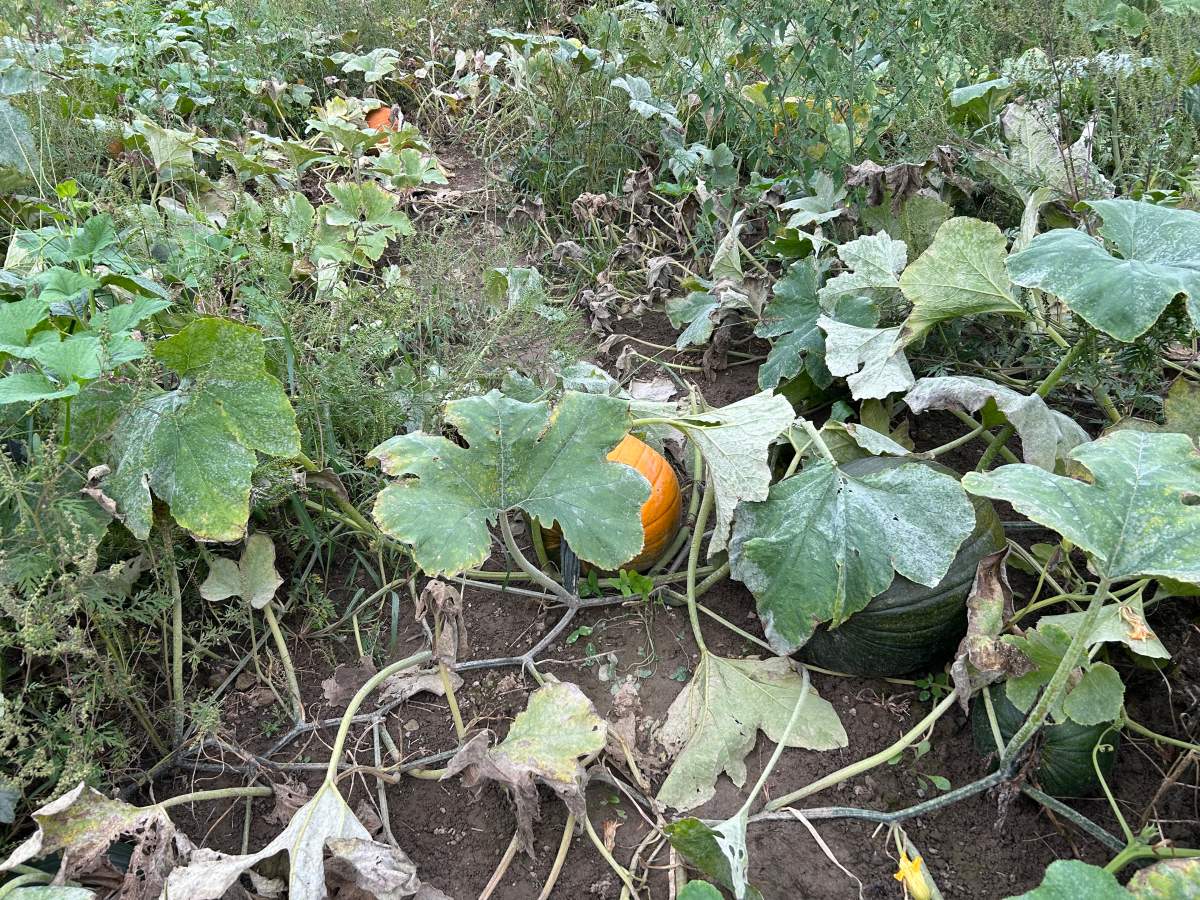
When pumpkin vines and roots remain wet, Mackay said they can develop fungal diseases that damage the plants and interfere with their growth. Persistently wet ground can also cause pumpkins themselves to rot.
“I was just in the patch yesterday walking around, and we saw a lot of powdery mildew,” he said.
Some pumpkins have already started rotting “due to the heavy rains we’ve had over the last number of weeks.”
Mackay said the intensity of some recent weather events and how localized they can be has made farming particularly challenging.
“It’s been a very tough season for weather and it’s very isolated storms,” he said.
The hailstorm that hit his Port Perry farm, for example, affected an area spanning only a few country blocks.
Similar uncertainty is playing out in the Niagara Region.
'We're at the mercy of Mother Nature'
Donna Warner, who has been farming for about 40 years and owns Warner Ranch and Pumpkin Farm with her husband in Niagara Falls, said this year’s pumpkins are developing later and in smaller numbers than she would normally expect.

Get daily National news
“The ones I have are beautiful. But again, there’s not as many,” she told Global News.
Warner said heavy rain could have affected pollination at a crucial point in the growing season. She experienced similar conditions last year, when pumpkins continued ripening well beyond their usual selling window.
“Last year, my field was orange in November,” she said, noting that pumpkins “don’t sell in November.”
Warner’s farm escaped the flooding and hail that affected some other parts of Niagara this year, leaving her hopeful that her crop can still catch up.
For farmers dealing with increasingly unpredictable conditions, Warner said there is only so much they can control.
“We’re at the mercy of Mother Nature,” she said.
Warner said recent weather patterns could change the way farmers irrigate and adjust by changing planting dates, irrigating during dry periods and staggering plantings to reduce the risk of losing an entire crop at once.
The effects of this year’s weather extend beyond Ontario.
Extreme heat and drought
In British Columbia’s Okanagan region, extreme heat and drought have instead pushed some pumpkins through their growing cycle much faster than usual.
At McMillan Farms in Kelowna, some pumpkins were ready roughly two to three weeks ahead of schedule.
“This year, because of the heat that we’ve had, it’s been pretty consistent, you know, day and then into the evening, so a lot of the pumpkins have been growing really well,” farm owner Ron McMillan said.
Some pumpkins that would typically take about 90 days to grow reached maturity in roughly 45 days.
-
![]() ‘My hydronyms are Lake and Ontario’: Merch takes aim at Trump’s ‘Lake America’
‘My hydronyms are Lake and Ontario’: Merch takes aim at Trump’s ‘Lake America’ -
![]() ‘Maybe I should remind Donald’: Carney chats with Banff residents
‘Maybe I should remind Donald’: Carney chats with Banff residents -
![]() ‘Egregious behavior:’ Brampton mayor, auto workers outraged as Stellantis decides to sell Brampton assembly plant
‘Egregious behavior:’ Brampton mayor, auto workers outraged as Stellantis decides to sell Brampton assembly plant -
![]() Ongoing rain halts seeding but farmers are optimistic
Ongoing rain halts seeding but farmers are optimistic


“When you have heat and drought stress, it tends to push plants to go to maturity more quickly,” said Deborah Buszard of the University of British Columbia’s Okanagan campus.
And on the Prairies, weather uncertainty has also complicated the traditional fall season.
Black Fox Farm and Distillery outside Saskatoon stopped growing pumpkins last year after dealing with unpredictable yields.
“One year we got completely frozen out, had no pumpkins at all,” co-founder John Cote said.
The uncertainty can be particularly costly for farms that rely on pumpkin patches as fall attractions because operators must prepare for visitors long before knowing exactly how the crop will turn out.
In Alberta, an unusually wet summer has also created problems for pumpkin growers, with some farms considering bringing in pumpkins from elsewhere as their local crops struggle.
“This has been a really rough year for us,” explains Kate de Windt, co-owner of Somerset Farms in Alberta’s Parkland County.
“Our crops are about a month behind, and as most people in Alberta know, frost can come very easy and early,” de Windt added.
Still, the conditions aren’t bad everywhere, underscoring just how localized and unpredictable the growing season has become.
At Springridge Farm in Ontario, a cooler, wet spring delayed planting slightly, but heat and rain later in the season ultimately helped the crop.
“Lots of pumpkins and good size due to all the rain,” farmer John Hughes told Global News in an email.
Mackay’s family also expects to have enough pumpkins for customers this fall. Because the family grows across three different locations and produces more pumpkins than it needs, Mackay said visitors should see little difference at its farms despite the losses.
“We’ll have a reduced pumpkin crop at Pingle’s, but still lots for pick-your-own and for customers purchasing directly from the farm,” he said.
The experiences suggest Canadians shouldn’t necessarily expect a widespread pumpkin shortage this fall. Instead, growers say the bigger challenge is not knowing what the next severe weather event could mean for their crops.
The Ontario Federation of Agriculture (OFA) said supporting local agriculture remains important as farmers navigate those conditions.
“Whether you’re shopping at a grocery store, farmers’ market or farm stand, take a closer look at where your food comes from. You might be surprised by just how diverse Ontario-grown food is,” Tracey Arts with the OFA said in a statement.
“This is why it is so incredibly important that we protect our farmland and our ability to grow and raise as much food as we possibly can right here at home.”


Anonymous is a village idiot
Huge full boxes outside grocery stores. No shortage seems.
Hopefully pumpkin pie is still available. I love it
Yes. No. I understand. I see. Slfjdjaidjjcksksndjdj29377282-$-$kdfnsk82477
From 2011–2025 $13+ trillion dollars has been spent on climate change. Has anyone noticed a change?
During the 1800s western Canada was very wet. Rain, hail, snow. A lot of land that farmers use now were under water. The early 1900s was very dry, droughts, dust storms and massive crop losses. The last 50 years have been relatively calm.
EVERYONE IS AT THE MERCY OF WEATHER !!! ALWAYS WAS, ALWAYS WERE, ALWAYS WILL BE ! WHAT F/ G NEW ??? CALLED MOTHER NATURE
Since when have farms not been at the mercy of the weather. Some years are good some are bad why is this the headline of the day. There mustn’t be more important news happening in Canada.
Pumpkins are an agricultural waste. If you’re not going to eat it, don’t grow it. The entire industry should be abolished.
Better in Ontario than Western Canada. Elbows Up Canadians were hoodwinked into believing paying a tax would prevent these events.
Hopefully these farms are in Ontario so they can get liberal bail outs.
We have a family farm outside Saskatoon. Every year the growing season is different. There isn’t “climate change” as it is always changing as has since our family got the farm almost a hundred years ago.
” ‘at the mercy of Mother Nature’
Well, duh, All farms are at the mercy of mother nature.
@Ben who doesn’t know the earth has warmed and cooled over millions of years
So normally everyday events are now news ?
Or are you just extremely lazy
Another excuse for the price of pumpkins to skyrocket just like everthing else it’s all Trumps fault.
Typical con reply below.
Attention Ben:
…………………./´¯/)
………………..,/¯../
………………./…./
…………./´¯/’…’/´¯¯`·¸
………./’/…/…./……./¨¯\
……..(‘(…´…´…. ¯~/’…’)
………\……………..’…../
……….”…\………. _.·´
…………\…………..(
…………..\………….\…
Prairie farmers are under water with actual food crops….
BUT NO NOT THE ONTARIO PUMPKINS!!!!!!
I though the Trudeau/Geebo carbon tax was going to solve this….
More extreme weather is coming courtesy of man made global warming. The IPCC and NOAA have stated this. Global warming deniers, constantly confuse weather with climate.
Yawn. Quick, go stop weather silly humans…
“Come meet someone who might catch your attention instantly😉” ………………………….> fillboards.com/girls33