

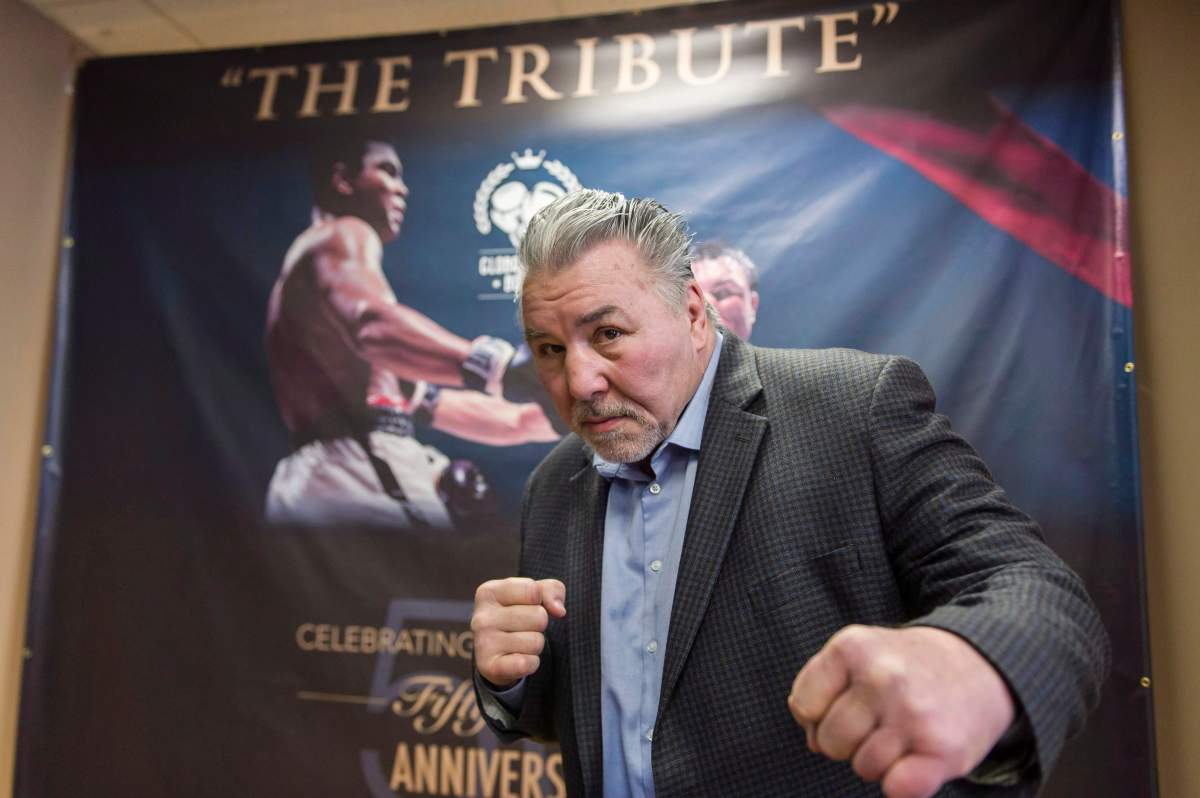
George Chuvalo, a hard-nosed heavyweight who never hit the canvas despite taking on the world’s best boxers, has died.

Sully’s Boxing Gym in Toronto, where Chuvalo trained during his career, confirmed his death in a social media post Saturday. The gym said Chuvalo died on his 89th birthday.
“Today, Sully’s lost a piece of its history,” the gym said.
Ontario Premier Doug Ford also paid tribute to Chuvalo, calling him “a heavyweight boxing legend, a family friend and a Canadian icon.”
“My thoughts are with all of George’s family and loved ones as we mourn his passing,” Ford said in a social media post.
Chuvalo was a Canadian amateur champion at 17, held the national title as a pro for almost 20 years and was ranked as high as No. 2 in the world.
He was 73-18-2 as a pro with 64 knockouts in a pro career that stretched from 1956 to 1978.
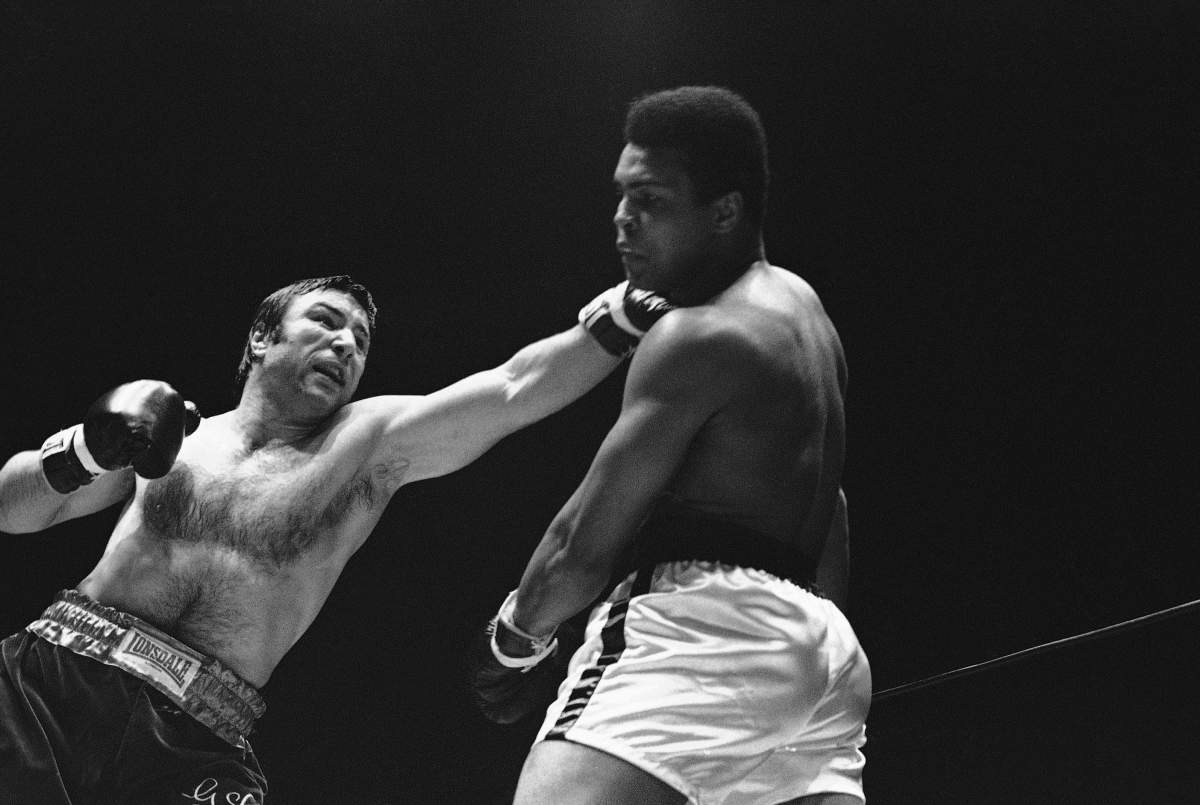
His career was defined by two mega-bouts with Muhammad Ali, in 1966 at Toronto’s Maple Leaf Gardens and 1972 at the Pacific Coliseum in Vancouver, in which Chuvalo drew kudos for standing toe-to-toe with the most gifted and charismatic boxer of the era.
“When people think of me, they think of me fighting Muhammad,” Chuvalo said. “But I had close to 100 fights.”
Known for having one of the best chins in boxing, Chuvalo pointed out that it took more than the ability to absorb punches to record 73 wins and rank in the top 10 in the world in an age of heavyweight greats like Ali, Joe Frazier and George Foreman.
Chuvalo took pride in noting he had more knockouts than Joe Louis and Jack Dempsey, while also exceeding the total number of fights that Ali, Frazier, Rocky Marciano and Mike Tyson had.
Before retiring in 1978, Chuvalo wrote in his 2013 autobiography “Chuvalo: A Fighter’s Life: The Story of Boxing’s Last Gladiator, “I’ll be remembered as a guy who fought the best of his time, beat a lot of them and lost to some others.”
He was never knocked down as a pro.
“Not in the ring, anyway,” he says. “Outside the ropes has been a different story.”
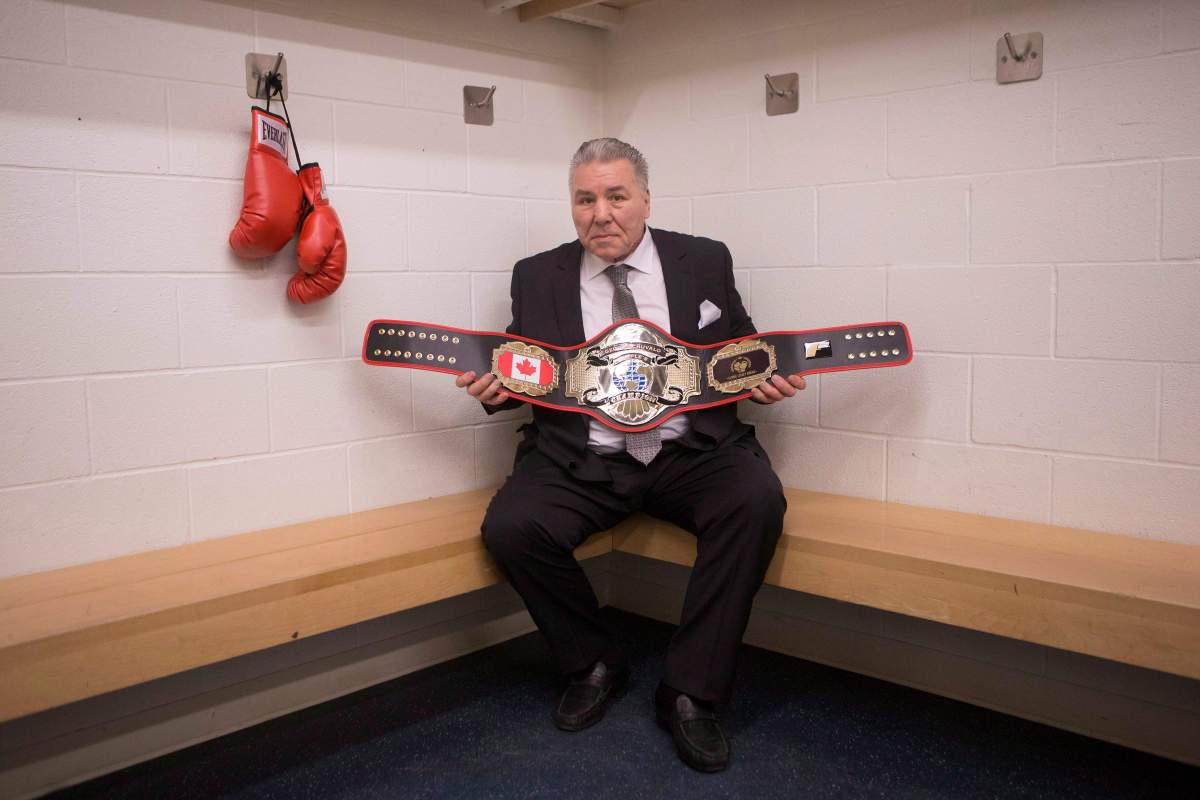
Chuvalo lost three sons and his first wife Lynne to drugs and suicide.
“If you added up every punch I ever took and then multiplied the total by 10,000, it wouldn’t begin to equal the pain of losing three sons and a wife to drugs and suicide,” he wrote.
As for his fights with Ali, the American legend made most opponents look slow and predictable, but he could not finish Chuvalo, even though the stocky fighter who liked to get in close and work the body had only 17 days’ notice to prepare.
Get daily National news
“They had a contest between a bull and a bumblebee at Maple Leaf Gardens last night,” Toronto Star columnist Milt Dunnell wrote at the time. Dunnell would add, “The bull came out of it with his face looking like a bucket of balls at a golf driving range.”
Ali went a full 15 rounds for the first time and had to go to the hospital for internal bleeding, while Chuvalo said, “I went dancing with my wife.”
When it came to his payday, Chuvalo said he ended up with $12,500, as manager Irving Ungerman took the lion’s share of the $49,000 purse, after expenses.
Chuvalo would also lose a rematch to Ali six years later by 12-round decision.
Despite the defeats, the Ali fights made Chuvalo a star in Canada and in the boxing world as the tough, unrelenting underdog.
“Icon — that’s the only way I can describe George Chuvalo,” said Lennox Lewis, a Canadian boxing star of another generation.
“He gave as good as he got, and then some,” reads Chuvalo’s Canada Sports Hall of Fame bio. “George Chuvalo was an extraordinary fighter and competitor — inside and outside of the boxing ring.”
Chuvalo was the son of Croat immigrants.
His mother worked in Toronto as a chicken plucker at Royce Poultry Packers, owned by Ungerman’s father, Chuvalo’s future manager. His father was a cattle skinner at Canada Packers.
George said he was drawn to boxing as a boy after seeing a copy of The Ring, a magazine known as “the Bible of boxing.” He egged his mother to get him boxing gloves, which she eventually bought at Eaton’s department store.
He found a local church that offered boxing training and had his first organized fight at age 10, an exhibition bout declared a draw. He eventually joined a boxing club and by 15 was a 198-pound heavyweight.
He fought 19 times as an amateur, losing just once. In May 1995, he knocked out Peter Piper in Regina to win the Canadian amateur title.
Chuvalo was chosen to represent Canada at the 1956 Olympics in Melbourne but turned pro instead.
He went on to become a five-time Canadian heavyweight champion, back when that title still counted, and held it for most of his 20-year pro career.


He lost a World Boxing Association championship bout to Ernie Terrell in 1965, a fight he always felt was fixed by mobsters.
A frequent fighter at Madison Square Garden during that time, going 3-6 against top pugilists like Frazier, Foreman, Floyd Patterson and Buster Mathis. The Ring named his bloody 1965 encounter with Patterson fight of the year.

He hoped to challenge for the Commonwealth title, but could not convince English champion Henry Cooper to fight him. He felt the Canadian Boxing Federation also let him down by not insisting that Cooper face him.
His last bout was a TKO win over George Jerome, a logging camp cook from Vancouver, who was the No. 1 contender in Canada, in December 1978 at Toronto’s St. Lawrence Market to retain the Canadian title. Chuvalo was 41 and made just $7,500 for the bout.
A bloody Jerome lasted two rounds before the ring doctor stepped in.
Out of the ring, Chuvalo was a big, friendly man who loved telling stories and making jokes. But his painful moments were almost beyond imagination.
In 1985, his son Jesse, who began using painkillers after an accident and developed an addiction, committed suicide. In 1993, another son, Georgie Lee, died of a drug overdose. Four days later, his wife was found dead with a suicide note.
Then, in 1996, his son Steven was found dead in a hotel room with a needle in his arm.
“After Steven died, I was barely able to function,” Chuvalo wrote in Toronto Life in 2013. “I felt like I was suffocating every time I went to sleep in the dark.
“I blamed myself for my sons’ deaths — for letting them quit high school, for not putting them in rehab earlier.”
He remarried to Joanne O’Hara and began visiting schools across Canada to deliver an anti-drug message. He had two remaining children and said he turned to “mush” whenever he saw his grandchildren.
Chuvalo, inducted into Canada’s Sports Hall of Fame in 1990 and the World Boxing Hall of Fame in 1997, was named to the Order of Canada in 1998.
Canada added him to its Walk of Fame in 2005.
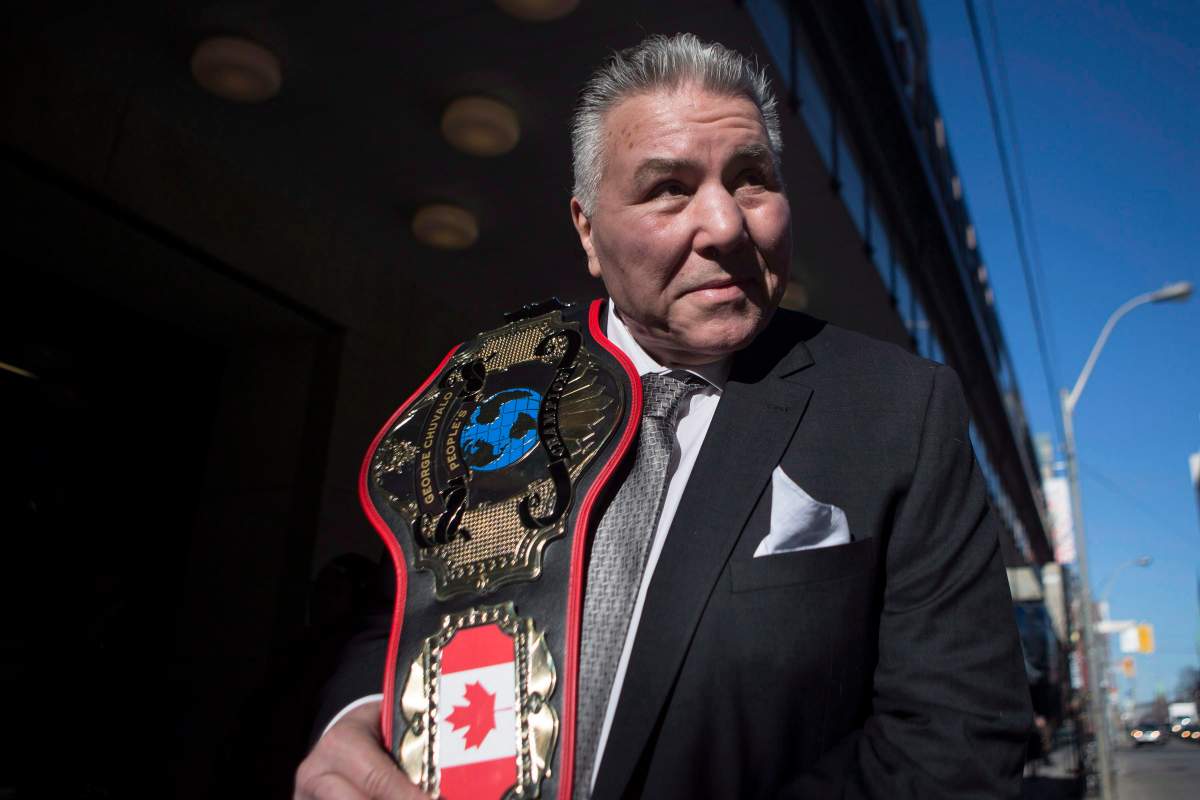
A statue of Chuvalo was erected in his family’s ancestral home in Ljubuski, Bosnia and Herzegovina, in 2011.
Some 24 years after his induction into Canada’s Sports Hall of Fame, Chuvalo took part in a new conference at Mattamy Athletic Centre, site of the old Gardens, honouring the 2014 inductees — and the bell he answered 15 times against Ali some 48 years earlier.
Chuvalo, then 77, rang the bell, gave the crowd a thumbs-up and then shadowboxed.
“I get reminded of it just about every day of the week,” he said of his first fight with Ali. “That makes me very, very proud to be a Canadian.”
The bell was donated to the Hall of Fame by Michael Shillolo, whose father, Frank Shillolo, used to be the official bellman for the Ontario Athletics Commission.


RIP Champ
Just a thank you to NICK of http://WWW.RANTINGLY.COM for accepting my request to post the news of Mr. Chuvalo’s passing on his website.
Elbows Up!
My thoughts are with his family.