


Voters can begin casting Alberta referendum ballots in person at more than 300 stations starting Tuesday.

The province’s fall referendum has 10 questions: immigration policy, constitutional reform and whether to remain in Canada or hold a binding, second referendum on quitting the country.
Advance voting locations are open Tuesday through Saturday from 9 a.m. to 8 p.m. On referendum day — Oct. 19 — just over 1,400 polling stations will open.
Here’s what to expect when you go to vote:
Where do I vote?
During advance voting, electors can vote at any advance voting location in their electoral division.
On Oct. 19 however, electors must vote at their assigned voting location in their electoral division and can’t vote outside their division.
There are three ways Albertans can to find both the advance voting locations and their assigned election day voting location:
- On their “Where to Vote” card sent in the mail to registered electors
- Election Alberta’s website under Where Do I Vote
- Or using Election Alberta’s online Where to Vote tool
Several rural areas will have voting location information published in their local newspapers, and specific communities such as First Nations and Métis Settlements will have posted local information where applicable
How long will it take?
Get familiar with the ballot questions ahead of time, which are on the Elections Alberta website. That will help avoid confusion and delays, election officials say.
They say they’re expecting a record turnout, between 80 and 85 per cent of Alberta’s nearly three million electors.
You have as much time as you want to fill in the ballots, but officials estimate it’ll take most people about two minutes.
Can I vote during work hours?
The Election Act requires employers to provide employees with paid time off (three consecutive, non-work hours) to vote during either one of the advance voting days or on Oct. 19. Employers are not allowed to penalize staff for taking time to vote.
Elections Alberta noted employer retains the right to determine when to give the employee time off — whether it is on any of the days of advance voting or on Election Day.
What identification is needed?
You’ll need one government-issued ID, with your correct name, current address and photo, such as a driver’s licence. You can use two pieces of ID that both have your full name, with one showing your current address.

Get daily National news
There are 50 forms of acceptable ID listed on Elections Alberta’s website that can be one of those two pieces, from a library card or a hunting licence to a bank statement or vehicle registration.
Elections Alberta says it will accept expired forms of ID, including a certificate of Indian Status Card, provided it still has the correct name.
Another option, in special circumstances, is to bring an attestation form signed by an authorized person such as a First Nation band manager or a student housing staffer.
The provincial agency said your “Where to Vote” card is not required to vote and cannot be used as identification, but it will speed up the voting process by helping election officers determine your correct voting area.
What if I’m not registered to vote?
A voting officer will ask you to sign a declaration that confirms your eligibility — including that you are a Canadian citizen, at least 18 years old and that you normally reside in Alberta.
What if I forgot to mail in my special ballot package?
The deadline for Elections Alberta to receive mail-in ballots was last Friday and the agency said it got back 391,000 of the more than 658,000 ballots requested ahead of the referendum.
Do not bring unsubmitted or unused special ballot packages or ballots to a polling station. Elections Alberta said they cannot be accepted for in-person voting or for disposal.
Special ballot packages that didn’t get used should be disposed of at home in the same way you would any confidential mail that contains your personal information, such as by shredding.
Recording rules
Smart glasses and recording devices may not be used in voting or counting locations, Elections Alberta said on Tuesday.
You may use your mobile phone to text or access apps, but you are not allowed to record, take photographs, watch or listen to content with sound, or take phone calls.
Devices must be on silent or headphones/earbuds must be used so as to not disturb other voters or disrupt the voting process.
How many ballots are there?
There are 10 ballots, in different colours for easy identification. You can mark some of them, all of them or none of them. Your choice.
The ballots will go into separate boxes to make it easier to count them, and to lessen the chances of a mistake spoiling one long ballot.
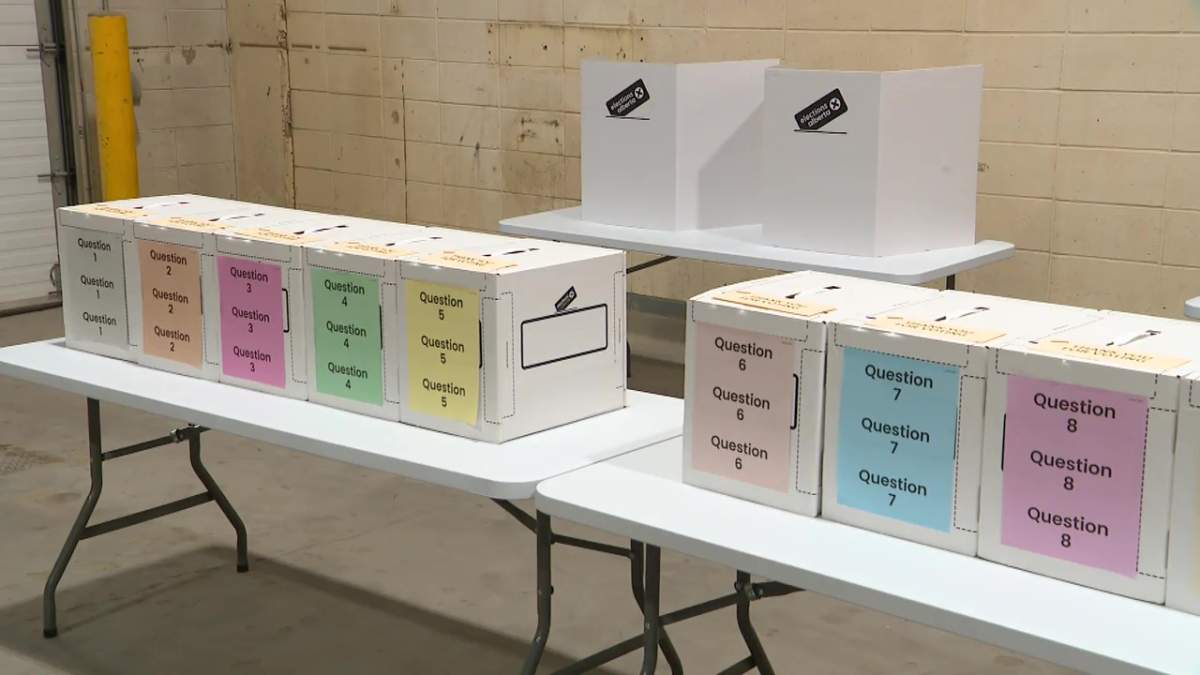


What are the questions?
The ballot contains 10 government-initiated questions dealing largely with immigration and constitutional reform, although public attention has focused on the final question asking Albertans whether they want to remain in Canada or proceed to a second, binding referendum on leaving Confederation.
The question: “Should Alberta remain a province of Canada? Or should the government of Alberta commence the legal process required under the Canadian Constitution to hold a binding provincial referendum on whether or not Alberta should separate from Canada?”
Elections Alberta encourages voters to read the questions in advance and understand what they mean, for two reasons: in order to speed up the voting process and also to familiarize themselves with the topics.
The agency said staff at polling stations are not allowed to help explain what the questions mean or the intent of the questions.
The vote, announced Feb. 19, initially contained the first nine questions pertaining to immigration and the Constitution. Then on May 21, Premier Danielle Smith announced a 10th question was being added, putting the issue of Alberta separatism in the hands of voters.
What if I’m still in line when the polls close at 8 p.m.?
Stay in line. Don’t leave. You will be allowed to vote.
How long before I know the results?
By law, the votes need to be counted by hand within 48 hours and once the polls close, Elections Alberta said the counting won’t stop until it’s done.
The results website won’t show any information until all voting locations in the province are confirmed closed.
Results will be reported live, in real time as counts are completed and returning offices confirm and enter them in the system.
The first question to get tallied will be number 10 — the question about separation — and officials say early results will begin to be released after 8 p.m. on Oct. 19, with the final count announced in the early hours of the following morning.
The results of the other nine questions will be done afterwards, in order from one to nine, and should be completed and announced by Wednesday.
The count timelines will depend on voting location closing times and voter turnout.
For more information, visit Elections Alberta’s website.

-
![]() Alberta referendum: Where does the separatist movement go from here?
-
![]() Advance polls open across Alberta in historic referendum on separation
-
![]() Ottawa, Alberta highlight military defence partnership ahead of referendum
-
![]() Global News Investigates: Road to the Referendum
-
![]() Road to the Referendum: what’s next as dueling campaigns compete in Alberta?
-
![]() Taber billboard causes boycott concerns for southern Alberta town
-
![]() Road to the Referendum: Ipsos on poll showing Alberta separatism support is dropping
-
![]() Treaty 8 chiefs vow to stop Alberta separation referendum
-
![]() Road to the Referendum: Concerns, uncertainty on how Alberta independence could impact economy
-
![]() Road to the Referendum: Moshe Lander on the economic impact


With files from Karen Bartko, Global News


Anonymous, there it is….what it’s all about. Cancer in the covid shots lololol. You need to get offline and read a book or two.
Most people do care about this silly referendum. It is just a few passionate people on each side of the fence that is making a fuss about this referendum and i don’t want that as a liberal .Alberta separates then we are screwed
SEPERATIST – OUT – EAST INDIANS IN
YOU’RE NOT WANTED HERE IN YOUR OWN PROVINCE YOU LIVED ALL YOUR LIVES
. TAKE HIWAY 2 SOUTH AND KEEP GOING.SO US ELBOWS UP LOSERS CAN TAKE OVER
SEPERATIST – OUT
YOU’RE NOT WANTED HERE. TAKE HIWAY 2 SOUTH AND KEEP GOING.
I am a crack head .I have no idea what i am saying but makes sense to me at the time
Yaaaaaaa freedumb
Elbows fly
Cons rule
Pierr pulley for prim mister
Go airdry
Most people don’t care about this silly referendum. It is just a few passionate people on each side of the fence that is making a fuss about this referendum.
Vote to leave. Take north of Hope BC with ya.
More Chinese employees than seems plausible?
From birth to death, libscum is libscum, in their DNA
elbows up ..you need to GROW UP! you all act like babies cant get your own way so you lash out ..well F u to! Alberta needs to separate you idiots destroyed Canada enough , EVERYONE I KNOW IS VOTING FOR SEPARATION THERE IS NOTHING YOU CAN DO ABOUT IT !
Get OUT TRAITORS!!!
You want to leave??
LEAVE!
DONT SAY YOU WANT TO LEAVE JUST TO STAY…two faced morons you need to be dumb like us liberals and stay in Canada and be over ran with immigrants, so they can take over and turn this place into a third world country because most of us will die from cancer that was in the covid shots, and they are our replacements, pay high inflation and let your tax money be given away to fund corrupt countries so the liberals can wash it and hide it in their bank accounts
Get OUT TRAITORS!!!
You want to leave??
LEAVE!
DONT SAY YOU WANT TO LEAVE JUST TO STAY…two faced morons