Grading homes: The system I used when picking a new place to live
This morning — because the sky was clear and I hadn’t anything better to do — I let the dog lead me on a six-mile walk. For two hours, we wound our way through the streets of Corvallis. We sniffed drains, barked at squirrels, and in every way had a merry old time.
If I’d allow her, Tally would spend hours every day sniffing drains around the city.

As we walked, I reflected on how fortunate Kim and I were when we decided to move here. We were deliberate about our choice, sure, but it was still something of a gamble. Sometimes research and experience don’t align. In this case, they have.
Why We Love Corvallis
After four months Corvallis seems like a perfect fit for us. There’s so much we love about this place, such as:
- The downtown remains vital and whole. Kim and I spent three months this summer exploring dozens of towns in western Oregon and Washington. We discarded many strong candidates because their downtowns were either decayed (often due to a freeway having been built a couple of miles away) or, worse, bisected by a busy highway. There is a highway through downtown Corvallis, but traffic is managed sensibly for pedestrian access. The freeway is fifteen minutes away. As a result, the central business core seems to be thriving.
- The city is great for biking. Portland has a reputation for being a top U.S. cycling city, but Corvallis is actually ranked the best biking town in the state of Oregon. (Portland has a Bike Score of 82; Corvallis has a Bike Score of 84.) The cyclists here like to complain that things could be better (and that’s always true), but the reality is that bike lanes are ample and wide, cars seem to respect cyclists, and many residents opt to commute by bike.
- Corvallis is even better for walking. In 2017, long-time readers chided me when I moved from a walkable riverfront condo to a rural home in a hilly suburb. I love to walk. I get cranky when walking isn’t easy. Well, here in Corvallis walking is very easy. The city is relatively flat. The sidewalks are well maintained. Downtown is great, as I mentioned, but the neighborhoods are designed to make walking for errands relatively painless. My favorite feature? The city has deliberately incorporated “active travel corridors” into neighborhoods: short paths that cut between properties in order to connect streets, parks, and so on.
- The city is surrounded by endless hiking trails. There are so many trails, in fact, that I cannot find one website that lists them all. (Here are the trails I hike most often. Here’s another set of trails I’ve been exploring with Jeff, the Happy Philosopher.) Now that the weather has turned cold and soggy, I’m spending less time in the forest, but when the sun returns to this part of the world, the dog and I will walk in the woods nearly every day.
- The city loves reading. This is no surprise, I suppose, considering Corvallis is a college town. Oregon State University is the city’s largest employer (contributing a whopping 27.6% of all jobs in the area). This has some interesting side effects, and one of those is books books books. Residents love the public library, yet they also support three local bookstores. Best of all, there are 144 little free libraries scattered throughout the city. (And after I finish writing this article, I will order my own little free library kit so that I can add #145.)
- The restaurants are better than we expected. It’s no secret that Kim and I enjoy dining out. Portland has a great restaurant scene, and we’d become spoiled by easy access to great food. We were worried that Corvallis would disappoint us in this regard. And while there’s no doubt that our options are much more limited, we’ve still been able to find several places that we enjoy. (Top of our list is a joint called Cascade BBQ, which has great food and great beer.)
There’s so much more we love about Corvallis: the traffic (or lack of it), the people, the parks, the wildlife, the culture, and more. Plus, to balance things out, there’s another town of similar size (Albany) just twenty minutes away — and that town provides some of the things that Corvallis doesn’t (Costco, etc.). Suffice it to say that we feel like we made the right choice when we elected to move here.
My System for Grading Homes
During this morning’s dog walk, I also recalled the rating system I developed during last summer’s home search. I had intended to write a GRS blog post about this in July, but then got distracted by the actual process of, you know, buying a house.
Here’s how my system works.
When evaluating a potential home, I rate it in five categories: region/city, neighborhood, property, structure, and “other factors”. These categories are very much subjective. And, in fact, your personal preferences might change over time. (Mine sure have!) I score each category with a letter grade: A, B, C, D, or F.
- First, there’s the region and/or city in which the home is located. Kim and I like to believe we could live anywhere — and we probably could — but there’s no doubt that we prefer some places to others. Portland once earned an A from me. Now I’d rate it a B- or C+. Cities like Orlando or Houston earn an F from me. I know many people love these places, but I hate them. Corvallis rates a solid A.
- Second, there’s the neighborhood where the home is located. I’m always surprised at how my personal experience living somewhere is affected by neighborhood culture. This is something that can be tough to determine when shopping for a home. It’s dependent on a number of factors (and those factors differ from person to person). For me, top neighborhoods are safe, walkable, and quiet. The neighborhood we chose here in Corvallis rates a B+. It’d be better if it were closer to more businesses.
- Next, there’s the property on which the home is located — the physical grounds. Not everyone cares what kind of property they own, but Kim and I do. We like to spend time outside with our beasts. Plus, we both like to do a bit of gardening. When househunting, we ruled out a couple of places because the yards were too small and/or unsuited to our needs. The yard we now have isn’t perfect — too many deer, too much shade in back — but it’s nice. I’d give it a solid B+.
- Fourth, there’s the house itself. How well does the structure suit our wants and needs? The house we recently purchased seems has been great. Functionally, my only real complaints are that the kitchen layout is funky and that the living room is too large to be cozy. The house itself is huge (especially for two people!), and that may prove to be an issue in the future, but for now we like having separate spaces for everything. The house earns an A-.
- Finally, there are “other factors” that affect the desirability of the home. These include things like the inspection report, the price, the presence (or absence) of an HOA, and so on. This house had a great inspection (and we’ve seen no problems so far), but it did seem expensive because the current housing market is inflated. Because of the price we paid, I’d give this category a B+.
Once I’ve rated a potential property in all five categories, I convert the letter grades to a standard GPA. In the case of our current home, the five grades (A, B+, B+, A-, B+) average to an A-/B+ (3.52 gpa). Not bad.
With this system, perfect 4.00 homes are tough to find. In fact, we didn’t see a single one during the five months we were watching the market. Part of this was due to price, of course. When home prices are high, it’s tough to get an A in the “other factors” category. Even so, it was very rare for us to see a house that had full marks in city, neighborhood, property, and house. This leads me to believe that a “perfect home” does not exist.
Just for kicks, I decided to grade each of the homes I’ve owned in the past. These grades are based on my experiences living in each place, not on pre-purchase impressions and expectations.
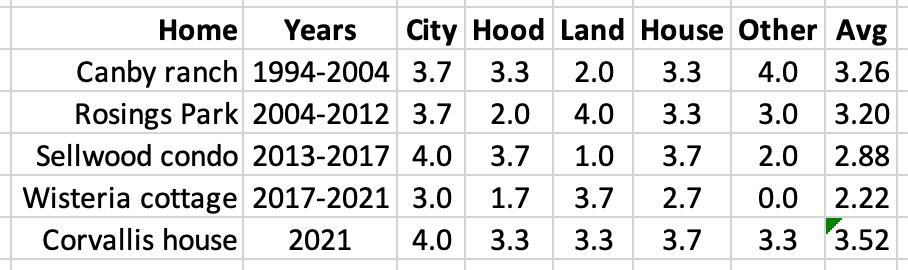
Kris and I bought our first home soon after we were married. It was a solid little ranch house with a good location in my hometown. Our second home, where she still lives, was a hundred-year-old farmhouse in a scrappy neighborhood.
After our divorce, I bought a riverfront condo. That place was fantastic except for the expensive HOA and the lack of a yard for pets. The country cottage that Kim and I just sold had an amazing yard, which was almost enough to redeem the place. Almost.
It’s early days yet on our Corvallis home, but so far we love it. The next two years will be telling as we work to upgrade both the house and the yard.

Final Thoughts
As I used this rating system to guide our search this summer, Kim and I found it useful to take a “top-down” approach. That is, we began our search by looking at the Big Picture, then gradually refined things until we found homes that we liked.
So, for instance, we spent the first three months of the homebuying process driving to dozens of different cities. Our aim was to find places where we really, really wanted to live. By being ruthless about eliminating options, we were able to only consider those towns that earned a grade of A or A-.
Once we picked Corvallis, we spent two weekends down here during which we simply drove around to get a feel for different neighborhoods. We wanted to figure out which parts of town worked for us.
Picking the right neighborhood can be tough. To really know where you should live in a city, you need to spend time there. This fact created a big debate between me and Kim, actually. I was keen on a neighborhood just south of the high school and close to downtown, but she was afraid it would be filled with noisy college students. We never could get a clear answer on the neighborhood’s character, so we eventually eliminated it as an option. (And after four months here, I still don’t know what that neighborhood is like!)
Once we had some neighborhoods picked out, only then did we begin viewing available properties.
I know this might seem silly to some of you, but this nerdy approach to homebuying really helped me. Combined with my spreadsheets filled with facts and figures, grading properties helped me to keep things in perspective.
Ultimately, we’re pleased with the choice we made. Kim frets that we paid too much for this house (but I think she’s ignoring the fact that we sold our existing home in the same high market), while I wish we were ever-so-slightly closer to businesses. Other than that, however, I think we made a good choice.
One thing’s for certain: The city of Corvallis is almost ideal for us and our family of beasts. I expect us to be here for a long time — perhaps forever.

Become A Money Boss And Join 15,000 Others
Subscribe to the GRS Insider (FREE) and we’ll give you a copy of the Money Boss Manifesto (also FREE)

There are 12 comments to "Grading homes: The system I used when picking a new place to live".
I agree completely. Set up a good/rigorous process and then trust the process to end up with a good result.
The first house I purchased, when I was a naive and inexperienced 27 year old, I knew the minute that I walked in that it was the right place for me. It was such a strong, visceral reaction. I adored living in that house. Fast forward 28 years and it was time to move on. The second time I went real estate shopping, I drew up a list of must have’s and wants and used it to evaluate each property I looked at. The property I ended up purchasing was the one that ticked off the most items on the list. But I didn’t “love” it – I didn’t have that visceral reaction to it, like with my house. But I bought it anyways (long story).
The result: every morning I wake up and pinch myself because I can’t believe how lucky I am to be living here.
I followed a similar system when we moved, and I value a lot of the same things as you do in a home. We don’t enjoy moving, and buying/selling a house is expensive so we wanted to make sure we ended up somewhere we would be happy to stay for many years.
I’m curious what factors go into your grading of region/city and what caused Portland’s grade to drop so much if you don’t mind sharing!
Lax city leadership over the last decade has led to a variety of systemic problems. Combine that with rapid growth over the past forty years, growth that has overwhelmed the city’s infrastructure and caused the housing market to skyrocket, and you’ve got a recipe for a struggling city. It’s not the chaotic city of rioters and communists that some would have you believe, but it has indeed become a dirty place where people don’t feel safe.
Just last night, Kim and I had dinner with a couple of friends from Portland. This pair used to have a house close in. They recently sold and moved away from the center of the city because they no longer felt safe. They described waking up to find that people had taken a shit on their front porch, and so on. I’ve seen the same thing on the downtown sidewalks: human feces and piles of trash. The fundamental problem is homelessness, and that’s a complex issue. I believe the stats show that it’s largely driven by high housing costs, but there are other aspects as well, such as drug use and mental illness. A couple of years ago, I met another money blogger for lunch downtown. We ate outside. While we were sitting at our table in a very public place (Pioneer Courthouse Square), we had a random homeless man begin to hurl trash at us from about thirty feet away. We got up and left, and the guy followed us and threw things at us. When we asked for help from law enforcement, they shrugged their shoulders and said there wasn’t anything they could do. At the last dental office where Kim worked before we moved, she’d often drive in to find homeless people and drug users camped on the doorstep. (She has one story about startling a young couple who were shooting up in the back of the place.) These aren’t isolated incidents. Every Portlander I talk to lately has stories like this. When visitors come to town (such as Carl from 1500 Days), they are shocked by how dirty the city is and how rampant the homelessness problem is.
Like I say, this is a complex issue. It’s not going to be solved overnight. In the meantime, though, locals like me have begun moving out.
But, as I say, it’s not just this. Portland has become very expensive (which contributes to the homelessness). Traffic is frustrating. Petty crime is ignored.
I still love Portland, and there’s much to recommend the city. But it’s no longer a place that I want to live. I don’t have any answers either. It’s very clear that the city needs to get a grip on its growing pains, but nobody seems to know how to do that. I have high hopes that, say, a decade from now the city will have smoothed things out. It’s going to take some time, though.
We lived in Portland for 10 years until 2017 just when it started going downhill. Sometimes we think about moving back but we know it’s not the same place we left. We miss it but its the people that have changed. It is such a beautiful place with all the natural resources.
Kim and I left for our cross-country RV trip in March 2015. We returned to Portland in June 2016. We were both shocked by the changes that had occurred the city during the fifteen months we were gone. And to our neighborhood. That — and our new puppy — led us to sell the condo and move. The continued decline over the next five years was one of the contributing factors to us leaving for Corvallis.
We moved from Portland too, about 3 years ago. We had lived there since 2007 and I completely agree with all your comments above.
A lot of the west coast cities up and down the coast are afflicted by what’s been happening. From Seattle, to Portland, to San Francisco down to LA and San Diego. I’ve lived in San Francisco from early 2017 to mid 2020 and spent weeks at a time in Portland and Seattle during that time. No way would I consider going back (We moved to SF part time when they required people to work in offices…).
While I do agree that this is a complex issue, which will take years to resolve, I don’t agree that this is primarily a homelessness issue (you used the word 5 times in your note). On the surface, “homelessness” is a convenient cover-all for what is happening, but it’s just a symptom of a number of other things, which all more or less root back to a lack of accountability.
Speaking for San Francisco specifically, the city has a district attorney who has made it his life’s mission to keep as many criminals on the streets as possible (namely drug dealers, but this attitude spans the gamut of crimes). Combine that with the decriminalization of larceny below $950 per incident and the fact that west coast cities pay cash benefits to anyone claiming homelessness, it’s hard to imagine how an environment like that won’t attract those in society who either are already heavy drug users or those who are vulnerable to that lifestyle. I’d stop short of saying “it’s all drugs”, but boy, it sure is 80-90% based on my own observations and the accounts of those who have lived through it and got out to the other side. Tom Wolf’s story is both enlightening and powerful, I recommend reading up on him – https://twitter.com/Twolfrecovery
Tom’s argument is powerful, he acknowledges that without someone holding him accountable for his actions, he felt permitted to do whatever he wanted, despite knowing it was wrong. One other argument he makes is that a lot of “homeless” drug users avoid the shelters provided by the various organizations because, well, they have rules for those seeking refuge there. He views those as common sense rules (no drugs / alcohol, be in by a certain time, no fighting / assault, no destructive behavior, etc.), but even those basic rules feel unacceptable to those who know that there are no rules in the streets and nobody will hold you accountable for your actions.
Things will not change, in my humble opinion, until cities, collectively, agree that shitting in the streets, public nudity, shooting up and discarding needles on the sidewalks, violence, larceny, and other behaviors in that realm are just summarily unacceptable and those that exhibit them need to be held accountable for their actions. That doesn’t mean they need to go to jail, but they ought to be given a choice: treatment and a path to sobriety, or removal and yes, thus punishment for their actions.
At the same time, DA’s need to prosecute every dealer that is caught. Catch and release, which is what is often done now, only has them back on the streets in a few hours.
West coast cities have a lot to offer with respect to potential quality of life, but that has been eroding substantially in the last few years and it’s getting worse, not better, which is very sad as I really enjoyed parts of our time out west but can no longer justify the risks.
Thank you for sharing those very detailed thoughts! I’ve heard the same things you describe from second-hand sources about Portland, so it was interesting to hear the same exact description from someone who lived there and saw it happen. It’s sad to see a place you love change in such a dramatic way.
This was a great post and thought provoking. It made me think of why I was living where I am. We are well into retirement and seriously appreciate the house in which we live. It’s small, 2 bedroom, which is what I wanted. Despite some early hassles with the HOA I am now grateful for them. I have seen some pretty awful things in neighborhoods that don’t have them. And they do take good care of the common areas. Also, it’s a senior living place which I have found that I adore, not because I have a problem with kids, but I have a serious noise sensitivity and can not live with the blare of music. All in all, this is by far my favorite home of the four we have owned.
On the downside, there is no lovely downtown to shop in, like you have. It’s So Cal, so all areas are heavy on convenience but seriously low on charm. Without a car one would starve. But I’ve lived in So Cal most of my life so I’m used to low charm.
By the way, does Kim just keep changing dental offices when you move?
When we bought our current home in 2019, we knew we needed acreage and no HOA. We knew the general geographic area we needed to stay in to be close to family, and we wanted somewhere with good schools for our kids. In this area schools tend to be really good or really bad without much in the middle.
It took some time, but eventually we found a property where the house was almost 3/8 of a mile from the nearest road down a long narrow driveway. The entire property is surrounded by trees and forest, and on one edge of the property we are bordered by about 1400 acres of Army Corps of Engineers wetlands that are crisscrossed with bike and hiking trails that we can access directly from our property. It is a dream. We have been so happy here for the last two years, and can’t believe our luck finding this place right before the pandemic hit.
I agree there are no “perfect” houses, but you can find some really great ones if you are lucky.
Love the home grading system J.D. I’m a day’s drive from you in NorCal, and have developed a grading system for our next home, though it was mainly based on location to amenities like parks, trails, libraries, and a grocery store. I think getting the feel of your neighborhoods is so important. Too many people just look at the house, but you have to be happy hanging out in your yard too!
I recently came across your entertaining post grading Corvallis homes like student papers, and just had to reach out to say how much I enjoyed it! As a longtime Corvallis resident, I found your impression of our town’s architecture through this humorous lens absolutely hilarious and insightful.
You perfectly captured the essence of neighborhoods like Southtown with the teacher-like commentary on craftsman bungalows and dutch colonials. The hippie vibes of Co-op housing and critiques of garish million-dollar homes had me laughing out loud in recognition. I will never look at certain ostentatious houses the same way again after your witty deconstructions.
While exaggerated for effect, your sharp observations pinpointed exactly what gives Corvallis its quirky charm and variety. Thanks for taking the time to offer an outsider’s anthropological study of our residential architectural ecosystem – a topic most take for granted, but you made fascinating. Really enjoyed this uniquely entertaining slice of local life!