Tips for the first-time investor

In a recent post regarding the survey of how people invest, the most glaring observation was that over 70 percent of respondents who have yet to experience a recession do not invest at all — not even a tentative first-time investor — nothing.
Since the survey didn’t record the ages of respondents, it is fair to conclude that those who had not yet experienced a recession would be aged in their mid-20s.
Why doesn’t this group of people invest? Several reasons were advanced in the comments and in other articles about the phenomenon. Some might feel they don’t have enough money to invest while others might be afraid to invest. But whatever the reason, teaching about investing can help address some of these concerns and hopefully get people started on their way — and for young people, this is especially important because they stand to gain the most.
Related >> How to Start Investing in Stocks
So, what is it they need to learn?
You Must Invest
Look around you at anyone over 60 or 70. How are they living? Chances are you will see or know some who is barely scraping by, and others who are living well. What is the difference between them? More likely than not, the difference between those who live well and those who scrape by is that one group invested and the other did not. Which of those two futures do you want to have? There is only one way to get that future: You have to invest. And it doesn’t have to be risky. We aren’t talking Wolves of Wall Street.
Related >> Best Lower Risk Investments for the Average Saver
1. The early bird truly catches the worm
Some may agree that it is wise to invest … but not right now. That is just foolish, and here is why: If you look at the chart below, you see that it shows the value of a $100 monthly investment yielding an average of 8 percent a year (the typical long-run yield on index funds):
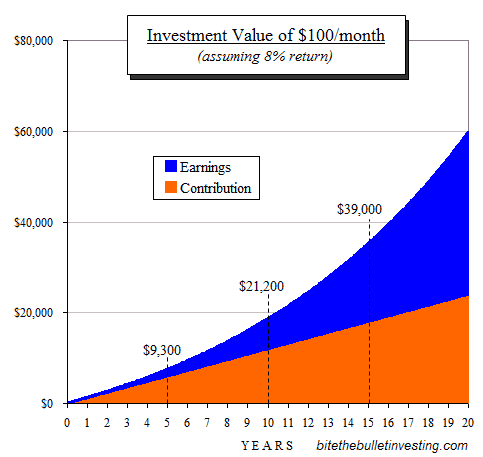
If you delay investing for, say, five years, you might think all you will be missing is the first $9,300, i.e., your investment’s value after five years. But you would be wrong, though — very wrong. The five years you will be foregoing are not the first five years, but the last five years. In other words, you’ll be foregoing the last $21,000, which is the difference between the $60,000 value after 20 years and the $39,000 value. That’s more than 50 percent of your investment’s value after 15 years.
It’s called the power of compounding — and it is a wonderful thing, but it needs time to work its magic. To get the full value of that magic, you have to start early.
Where do you get the money to invest, especially if you are still making “young money?” It has to come from spending less than you earn. It isn’t a popular answer, but it’s the only one that works. Far better to pull in your belt when you have a choice (now) than when you don’t have a choice (later).
How Do You Get Started?
The strategy that has stood the test of time the best is to pay yourself first. What that means is you need to set aside the amount you decide to invest before you pay anything else, from rent to the cell phone bill. And here are some ways to do that:
- If you have a job with a matching 401(k) or similar retirement plan and the employer offers to match a certain portion of your contributions, start by contributing the maximum the employer will match. That is free money, and it will double the growth of your investment. Passing up that free money will end up costing you dearly over your years of investing.
- If you don’t have an employer matching plan, consider opening an IRA. Most online brokerages offer those for free, with but a modest starting balance. If your employer offers online deposits for your paycheck, they usually will pay the amount you designate directly into your IRA — which is just another way to pay yourself first.
How to Open a Roth IRA
The link above discusses the basics and walks you through the process of opening a Roth IRA. It’s a great resource with just about everything you need to know, including:
- The four steps to opening a Roth IRA
- The information you need to open an account
- How to evaluate a Roth IRA provider
One thing few people talk about, but which ended up being one of the best things my wife and I did, was simply to open up a savings account and dump all the unexpected monies we received into it. Everyone that I have spoken to confirms this, and you will be amazed at how much out-of-the-ordinary money you get. Just this week we received a $21 rebate from our insurance company because of some changes we made to our policy. In the past, that would simply have been spent without a second thought; but since we opened that special savings account, all those amounts automatically go into it.
At the end of each year, that year’s “bonuses” were put into one of our IRAs. Over time, those little breadcrumbs add up to surprising amounts. We also observed a funny phenomenon: Once you start looking for breadcrumbs, they increase. You see more opportunities to score those mini-bonuses when you are always on the lookout for them.
Stay the Course
Every successful investor will tell you the same thing: Successful investing is boring. Success comes from patience, diligence and perseverance more than anything else. Brilliance and aggressiveness are more likely to cost you than add anything to your bottom line. Even Warren Buffett famously admitted that the secret of his success is that he mastered “the art of doing nothing,” his phrase for doing simple things and being patient. In short, let compounding do its work by giving it time and staying out of its way.
As you can see from the chart above, even if you start with small investments to begin with, they will grow to a sizable sum if you stay the course. Investing is not rocket science; it amounts to paying yourself first every month, even if you have to do without some small thing in the short term.

Become A Money Boss And Join 15,000 Others
Subscribe to the GRS Insider (FREE) and we’ll give you a copy of the Money Boss Manifesto (also FREE)

There are 43 comments to "Tips for the first-time investor".
Very interesting post. After experiencing my first full blown recession in 2008 I started a quest to save money. I guess the recession came to me at a great time when I was in my mid twenties and this has helped to strengthen my financial position mainly through being frugal and making more money. I now save about 80% of my income and invest in assets that pay income. The fear of being affected by the recession is still inside me but I think it has helped me to wise up about money.
“Success comes from patience, diligence and perseverance more than anything else.” Excellent recipe for success.
I just posted my “Accomplishment and Celebration” post yesterday as I have paid off the second of three rental mortgages in 24 months totaling $114,487. I am changing directions due to some life adjustments I mention in the post. Similar to investing, I mention that in my experience debt pay off and reduction requires three ingredients: 1) A plan 2) Determination and 3) Time. Those are the ingredients for successful debt reduction and investing.
Warren Buffett also mentions the importance of temperament (akin to patience) but with important distinctions.
Due to the plan, determination and time, I now enjoy $1,000 more per month in passive income than I did 24 months ago. As has so often been touted on these personal finance blogs: If you stick to the plan, the future you will thank the you of today.
Curtis I’ve followed your posts for a while and love seeing the updates!
I’m still new to the investing part of the personal finance equation — it seems like yesterday that my focus was saving every penny and putting it into a very low interest bearing savings account at a national bank.
But now that I’m no longer in crisis mode, I find this guide very helpful and I plan to take my first investing steps (outside of 401k which I use).
This is a good article and I recommend it to all, especially younger people. But the initial premise is flawed. It’s a good example drawing a conclusion from causality when all you really have is correlation. The author states “the most glaring observation was that over 70 percent of respondents who have yet to experience a recession do not invest at all” and goes on to suggest that these are people in their twenties. I would ask the question “what percent of respondents who are in their twenties do not invest at all?” If it turns out to be the same 70%, as I suspect, then we have no actual evidence that failure to experience a recession is a factor in their failure to invest – perhaps it’s just that those in their twenties are still struggling with getting started in life and perceive themselves to have higher priorities than investing at this time in their lives. (I could even conceive of a scenario where failure to experience a recession increases the investment ratio because people have more money to invest. The fact is that we don’t have enough data to draw any conclusion about what is causing them to fail to invest.)
But of course the article is right about the value of investing early in one’s career. I invested early in life but only because my employer essentially forced me to. My company had a profit sharing plan where the profit sharing went into a retirement program (this was prior to the days of 401Ks and the plan was changed to a 401K after such plans were introduced). What caused me to invest some of my own income was the company’s annual reports on the value of my retirement program and its projections of where I would likely be at retirement under various assumptions about my additional participation. I fear that the way things are going today, such paternalistic company practices are becoming a thing of the past (in fact, that very company had to switch to a “stock option” plan for recruiting purposes – their competitors were getting all the best talent by offering them immediate gratification instead of long term security).
Now I’m retired and reaping the benefits of having saved and invested so early in my life. It’s fine in theory to say that we shouldn’t have paternalistic companies or governments and each person should fend for themselves, but I fear the reality in practice is that if we do so we will have 70% of the elderly population living in poverty in a few decades.
Good Article, reminds me of my three and a half year journey and quench of creating a passive income stream.
I got my first real job in Singapore in 2011 and didn’t have much to start Investing here locally, so instead started with small amounts and invested in India and continue to do so even today but the amount has increased substantially, also make it a practice to increase the amounts every year in proportion to increase in income. Today I save about close to 60% if not more, of my income and though my employer does not have any planned contribution, by perseverance and discipline my growth assets are contributing more than my active Income and most likely will surpass it in the next one year. The initial small amounts are today enjoying the effect of compounding.
I am in my twenties and feel that our goals can be achieved with a little planning and patience with or money matters.
I think the point about “losing” $21,000 by not investing a small amount now should be stressed when talking to people. This is why working another year or two near retirement can be such a big deal, because the nest egg is so big the earnings are potentially rolling in those last few years. The flip side is the sooner you start the less likely you’ll need to worry down the road and you may not have to work those extra years.
Another problem is combating the fear when not understanding the market. You always see these nice, pretty, smooth curves based on average return. But it should be overlaid with the volatility of the actual market over that time so people know their money won’t always smoothly rise up. They’ll see that rises and drops and plateaus over time so when it goes down they don’t lock in their losses and sell and that they understand they may want to move assets away from that volatility as they near retirement.
I do believe the advice given here is good. I think it might be harder for people just starting out to follow because of the higher student debts and unemployment/underemployment for youths, but it’s still good advice, even if it’s not easy.
I have never understood why it is so difficult to start investing when you are young. When young you have not yet become accustomed to an expensive way of living. I started saving as soon as I started my first job. I was easy because I suddenly had so much more money than I had as a poor student. And once you start, it is very easy to keep it up, and find even more money to save.
On the other hand, as soon as you have gotten used to a high level of spending it is very difficult to start investing, because it means giving up something.
So start early. Not only because it is wise, but also because it is the only point in your life where it is relatively easy.
I’m so glad people like you encouraged me to start investing before I was used to spending what I made.
Hi. This article is a really good one for me. I learned to save more in my late twenties and it hasn’t been easy, but it’s been hugely rewarding. I recently paid off a credit bill of $9000 in two years. I am now ready to pay off my student loan and build up my emergency savings.
My question is whether it’s too late to invest at 37? I am saving and paying off these debts (and maintaining my mortgage)but I wonder if I should still invest beyond my retirement account?
I’d love to hear from others.
Thank you.
KK
37 is certainly not too late to start saving. Heck, I’m nearly twice that age and still saving. I find that one of the best techniques is to simply pretend your income is lower than it is. If you’re starting out, you pretend your take home pay is 20% less than it actually is and you put half of that into a Roth IRA (for retirement) and the other half into savings (to build up your emergency fund). Once you reach an emergency fund level of 9 months of income (think – taking time off work to have a baby) you can increase the retirement contribution to 15% and give yourself a “raise” or save for some future goal with the other 5%. You develop a lifestyle based on having 20% less income and before you know it you are in solid financial shape and able to weather serious emergencies, such as loss of a job. By the way, the following do not count as emergencies: vacations, weddings, recreational gear, buying a house. A true emergency is something like losing a job or having a serious medical expense that isn’t covered by insurance.
Starting at 37 you have probably already developed a lifestyle that will be hard to come down from but you can still save successfully. You’re already paying off loans and saving for an emergency, but take a small percentage of your income and start a Roth IRA (you may need something like $2000 to get it started to avoid fees). Getting started is half the battle. As you pay off those loans, increase your savings percentage until you get up to the 20% level. If you get a raise, devote half of the new take home pay to the savings/retirement program and if you get a bonus, put half of it into the emergency savings account until you get to the levels mentioned above. You may want to go above 15% in the retirement plan in order to make up for the younger years when you didn’t put anything into retirement. Also, if you have children, spring for TERM life insurance to protect them in case something happens to you. It’s still cheap at age 37 (and dirt cheap at age 20).
The last issue is what to invest in. For the emergency fund, an FDIC insured bank account or ladder of CDs is a good, safe choice. You want something that you can draw from when needed, even if the stock market has tanked that year. For retirement savings, you want to look at the long term. And from age 37 you have 30 years until a recommended retirement age. I’ve been highly successful with very basic, balanced funds and highly diversified index funds. Fidelity Puritan or Fidelity Balanced or Vanguard Wellington or Vanguard Wellesley for the balanced funds and Vanguard Total Stock Market Index Fund for a highly diversified index fund. All have been very good to me for a long time. I reinvested all dividends and came out very well after a 40 year career.
Never invest in a fund that has an expense ratio greater than 1% (Vanguard total stock market index has an expense ratio of less than 0.10%) or a front-end or back-end load (loaded funds and fees for managing your money are typically pushed by the more expensive investment “advisers” (salesmen, actually)).
Choose your IRA account custodian carefully. That’s the investment company, mutual fund company, or bank that actually holds your investments and takes care of all the paperwork for you. You shouldn’t need to pay any fees and there are plenty of low-cost companies you can go with such as Vanguard, Fidelity, T D Ameritrade, Charles Schwab, and many others. Some actually have physical offices, which you may find appealing. Any of these can start you off in a Roth IRA invested in the kinds of funds mentioned.
Never invest in anything that for which there is not a ready market. In other words, if someone proposes an investment, ask them how easy it is to sell it if you need to. Many investments are not publically traded and, hence, not easy to sell.
Stay away from insurance programs except for term insurance and, when you retire, for immediate annuities. They make poor investments, despite the well honed sales pitches. A good example of a poor investment is indexed or variable annuities. The return is based on stock market performance, but they conveniently forget to tell you about the dividends. Dividends are a significant part of one’s investment gain in the stock market and in an indexed annuity, the dividends typically go to the insurance company, not to you. What this means is that you get significantly lower return than you would have gotten by investing in the same index through an index fund and reinvesting the dividends.
And don’t forget diversification. That’s one of the big advantages of diversified mutual funds such as those recommended above. If you want to invest in individual stocks or REITs or other such investments, no single stock should be more than 4-5% of your total investment portfolio. Be especially wary of investing in your own company’s stock, if you work for a company. If the company gets into trouble, you may lose your job AND a significant part of your investment portfolio.
This is probably more than you asked for, but I hope it is all useful.
One last point – about those student loans you are paying off. If the interest rates are comparable, always pay off student loans before other debt. The reason is simple: in most circumstances, student loans cannot be discharged in bankruptcy, whereas other debt can. Imagine, for example, that you have $50,000 in student loan debt and $50,000 in credit card debt, both at 8%. If you had a serious setback and had to declare bankruptcy, you could wipe out the credit card debt but not the student loan debt through the bankruptcy process. So if you had paid off the credit cards but not the student loans, you would have a big problem – the other way around, a not so big problem.
I also factored in that most student loan debt is discharged upon death of the former student. As a non-traditional student, I felt waiting until last to pay off the lower rate student loan debt was the better option for my family long term.
I’m replying to an old comment, but the question is still relevant. It’s never too late. It’s always prudent to have an emergency fund and there are investment vehicles that will protect money from government programs that are income tested. (depending on your country of course, I’m from Canada and the US has some similar laws and registered investment programs)
I am investing in a combination of indexing and growth dividend stocks. Both will continue to compound even when I stop adding money to the investments. Allowing them to grow is simply a matter of ensuring less is taken out than what it generates through compounding. If this is done then the investments can continue to provide a growing source of income even as the person enters retirement and begins to take from the investments.
I plan to not sell my dividend stocks but to cash the dividends. If I have chosen well the dividends will continue to grow and compound, no matter how long I live.
At some point it’s a guessing game, unless you want to give the money charity or relatives, you should probably start taking out more so the principle begins to be depleted, after all, we don’t live forever. Sooner or later we are all going to die, and the money in the bank isn’t going to our corpses any good.
Some will die unexpectedly, but chances are if you’ve made it to 70 or 75, you might live until your nineties. My parents are 30 years older than me and in better health than me. My father has had cancer, and his parents and men on his side all died before their 60’s.
I will give all my money to my surviving spouse, she to me, and if we are both gone, to my children.
You may not be able to save 15 percent, but instead what you can afford to save. I’m saving between 15 and 20 percent depending on the year, but if it was entirely up to me it would be closer to 20 to 25 percent, with cutbacks on cable TV and discretionary spending. If you can’t save 15, save what you can, ensure you have an emergency fund. Try to put money in registered accounts that don’t effect income tested social programs.
I have relatives who are not saving at all, they spend every dime they get and more. They think they are going to be fine because they have good pensions, but I very much doubt it since they can’t get their spending under control and they just had to sell their house or face losing it due to a first and second mortgage, personal loans and credit card debt. They are going to face severe cuts in income, and when many are getting money from downsizing their homes, they will paying rent which is always increasing here. They might have to continue working well past retirement. That might be your case too, and many others. But it’s not the end of the world.
If you have to continue working you can still save and invest, your investments will continue to compound as you work. If you can’t work then any amount you have saved and invested will come in handy.
Have no doubt of that.
Hi. I am in my twenties and don’t invest as much as I should. However I would like to mention that I, and many other twenty somethings, graduated directly into the last recession, the effects of which are still impacting current wages. We have not just seen it but lived it.
I would also like to 2nd Dennis’s point: correlation is NOT causation. But even your correlation is suspect IMHO.
Lastly, while your topic of “save money, over time, because compound interest” is good and timeless advice, it’s not exactly earth-shattering. Would have liked to see more about the specifics: how much should I try to invest? Where should I put it? What should I look for in a company that is holding on to my money- what sorts of fees will they charge and what is reasonable? Give me some names to google and some how-tos of getting the accounts set up. I can save all the windfalls I want, but that doesn’t help when my savings account yields less than 1%. I believe GRS had a whole series of IRA posts long ago- link me to them, and then maybe update the information from those posts. Don’t just talk about how my generation doesn’t bother to invest and you don’t know why. It gets old.
See my response to Kandice for my suggestions on most of what you are asking about. And feel free to ask me more. One important point: the more you educate yourself about investing, the better off you will be. And remember the name of this site: get rich slowly. That’s how you do it.
Could you tell me where I can invest at 8% as you wrote?
I don’t know any investment that pays so high
Thanks
Mario,
There is no investment in the stock market that can guarantee you an 8% return. However what the author is talking about is that over time index funds have been shown to consistently return about 8%. I think the author did a good job of stressing that the important part for this 8% return is that it happens over time, not over night.
So given time, index funds can yield 8% returns.
Especially if you re-invest all dividends! That makes a bigger difference than you might think due to the “magic” of compound interest.
But:
1. what happens if you start investing in for example in january 2007 and you get the crash in 2008?
2.What about inflation, it is not considered in this article.$60.000 are no the same today than in 2034.
3.Which index fund do you recommend to invest?
Only one or many?
The SPY?the DOW?the NAsdaq?
4.If after 5 or 10 years you account grows, wouldn´t ir be wiser to diversify?
Thanks please help me understand.
I am from Argentina and renting Real State ROI right now is around 2% in US dollars.
I spent months looking for other options but didn´t finf anything.
I know I can invest in Facebook, Apple etc, but I only would invest 1% of my state on a stock
1.For me, if I began investing in 2007 and the market crashed in 2008 I would be really happy. But this is because of my financial situation, I can’t invest large sums of money at a time. I put in $100 every month so a market crash is great because I am buying more with every dollar. If you have a lot of time (I have 40 years until an early retirement) what the market does today makes no difference if you are steadily investing. Like Dennis said, re-investing dividends and capital gains is the golden ticket to really getting all the compounding interest.
2. I can’t speak to this because I do not know enough about the topic.
3. As far as I can tell most market track index funds are the same. You can get broad diversification right off the bat if you invest in a total market index fund. Also whatever bank or brokerage you have your money in may influence what index fund you choose. My brokerage has their own index funds that I can trade for free so I go with those. A market track index fund shouldn’t have a net expense ratio higher than 0.10% in my opinion since there is no active management.
4. See number 3.
Ben covered some of this. Note too that there are complications when you live in one country and invest in another – see below for more.
Re #2: Inflation. Over the long haul, stocks outperform inflation. If inflation averages 3% and stocks average 8%, you’re still ahead by 5%. That’s still going to serve you well over the long haul. If you aren’t willing to accept the risk of stocks, which is relatively low for a 30+ year horizon, you can go for a balanced fund (I mentioned several in an earlier reply), which has both less upside potential and less downside risk, but will still likely outperform inflation over the long run (all of mine certainly did). If you are really risk averse or have a very short time horizon, you can purchase inflation-adjusted bonds. For example, in the US you can purchase TIPS – which are bonds that pay a fixed percent PLUS inflation. Right now that fixed percentage is relatively low, but it does guarantee you a return that will beat inflation.
#3, #4: what to invest in. Getting back to stocks, most successful investors believe that stocks are the only way to go if you have a long time horizon, but only if you invest in a broad, diversified collection of stocks in economically strong countries. For someone in the US or who believes in the future of the US, I recommend a total stock market index such as the Vanguard Total Stock Market index fund (VTI is the exchange traded version). Other investment companies have similar offerings. Some would suggest, instead, investing in an S&P 500 index fund, which invests in the 500 largest US corporations. It is very similar to the total stock market funds except that it excludes about 3000 smaller companies that, all together, don’t amount to that much. The advantage of the total stock market approach is that if some of those small companies are successful (think Apple, for example), you have a lot of upside potential.
This of course is for the US stock market. If you live elsewhere, there might be a similar opportunity in your own country, if you believe it has stronger long term prospects than the US, or at least strong enough prospects that you are willing to invest in it. This sort of fund is inherently very diversified because it invests in the total stock market, or (in the case of the S&P 500 index funds) in the bulk of the stock market by value, so it is about as diversified as you can get unless you want to throw in a bit of international stock, in which case there are many total international stock market funds. Thus, re #4, you can just stick with this index for a long time. On the other hand, suppose you believe very strongly that a certain segment of the market will outperform the rest. Say, health care as an example. You could invest perhaps 10% of your money in a broad health care index fund. The narrower the focus of the fund, typically the higher the expense ratio and you don’t want to get something that has too high an expense ratio, but this is one way to be diversified and still invest in things you believe will be successful.
What you want to avoid is investing a lot of your money in individual stocks. This is the opposite of diversification – it is the riskiest approach you can use because individual stocks can have wild ups and downs.
—
About non-US investors: what it boils down to is that you have to make a judgment about how well your home country (or any other) will do in relation to others. This includes both economic performance and currency valuation, although these two tend to go hand in hand. A total international stock fund combined with a total stock market fund in a country you consider to have strong economic prospects is one way to diversify. If you are really averse to investing in stocks, it probably indicates that your home country has a not-so-good economic record. In that case diversification is even more important.
By the way, really rich people in any country tend to put a lot of their investments into stocks and bonds of other countries that they consider to be economically strong. The US, Germany, Australia, Switzerland and Great Britain come to mind, although there are many others that people consider to be strong. (The reason the Chinese and Japanese governments have so much invested in US treasury notes (bonds) is that they consider this a safe, conservative place to put their money. That ought to tell you something.)
A final note: Gold and other commodities. These go up and down wildly. They are classified as speculations because of that. You can make a lot of money this year and lose it all next year in commodities, so trading in commodities is considered a very risky kind of investment. Just look at the price of gold over the past ten years – or the past 30 years. You will find that over the long term it has not performed as well as the total US stock market index, but in the meantime it has presented investors with a very wild ride.
At the beginning of your article you state that young people that do not invest are a phenomenon, but you do not provide any evidence to support the argument that in previous generations young people invested in their future. Is it out of the ordinary for the 20-something generation to not be investors?
If we consider the current generation that is about to retire, where most of the baby boomers are working longer than they expected to in order to retire, doesn’t that provide evidence for the argument that regardless of what generation you are from young people do not invest?
For those that argue it was the recession that forced the baby boomers to work longer I would ask, if the baby boomers planned on retiring now shouldn’t their assets have been in a more stable investment 5-8 years ago?
-Concerned millennial
I’m a pre-baby-boomer (“war baby”), now in retirement (sort-of – I still work part time just to keep myself occupied in something productive). Many in my generation saved early, but largely because our parents had lived through the depression and drilled it into us that we needed to save for a rainy day or the future – my father’s goal was to “not be a burden on my children” after retirement. Also, for many of us, our employers sort of forced us to save for retirement(see one of my earlier replies). Even so, it was indeed tough for us to save when in our 20’s. Some of my friends used to gripe about how the employer’s contributions to retirement programs could be “put to better use” (i.e., given to us to spend as we wish). But many of us simply ignored that money the employer was socking away in our retirement plans and lived off of what we had, developing a lifestyle consistent with our take-home pay. I started saving for my retirement using my personal funds when in my early 30’s, mainly because of what my employer helped me understand about the future. It helped that I was a math/science/computer science specialist who understood the effects of delaying (the power of compounding). By contrast, many baby boomers had parents who grew up in the postwar period, a time of relative plenty, and they did not have the same saving mentality. The boomers, many of whom also retired much too soon, are now realizing their mistake and trying to warn you millennials to do what you can because the paternalistic employers of my generation (and theirs) are not as common for millennials.
Dennis,
Thank you for your insights. It would be truly interesting to me if there was some way to look at generation by generation how much was saved given what generation your parents were from to see if there is any relationship there. I would suspect there is but as all generations have gone through different situations seeing the variability in response by the next generation would be pretty cool.
What Ben said. Also, what Mario said. Is 8% something I can actually expect to earn? My student loans are at over 6%, so it occurs to me that paying those off first is a better bet since that 6% is guaranteed. Also, debt could be a contributing factor as to why young persons do not invest.
There are, indeed, many good reasons to pay off those student loans (see my earlier comments on this), but it is also a good idea to at least start a Roth IRA (when your income is low enough that your tax rate is relatively low, you are eligible to contribute to a Roth, and to start the clock ticking since some of the benefits require you to have had the Roth IRA for at least five years). As far as the 8%, that’s a long term number that includes re-investing dividends in a low cost, highly diversified index fund or a diversified balanced fund, such as those mentioned in an earlier reply of mine. Minimize expenses and fees! Ride out the ups and downs of the stock market. Passive investing like this really does work.
I would also add to Dennis’ comments about the Roth IRA. Pearl, if you have not attended school for any part of 5 months throughout the year and make less than ~$30,000 a year you can get the Retirement savings contribution tax credit that can lower the amount you pay in taxes (excluding social security and medicare) between 10-50% depending on a wage scale (link to the credit below). This was honestly the most convincing reason to me to really up my retirement contributions last year. You can open and make contributions to a Roth IRA until April 15, 2015 for the 2014 tax year. I would also add that this is a nonrefundable tax credit so unlike the Earned Income credit, once your tax liability is 0 you do not get whatever is left over as part of your refund.
http://www.irs.gov/Retirement-Plans/Plan-Participant,-Employee/Retirement-Topics-Retirement-Savings-Contributions-Credit-%28Saver%E2%80%99s-Credit%29
If i use this calculator:
http://www.investor.gov/tools/calculators/compound-interest-calculator
.Starting with $0
.Saving $100 per month
.During 40 years
.At 8%(which I thin is a lot)
Will give me $ 310.000 in 40 years when I will be 81 years old.
And $310.000 in 2034 will be around $150.000 aprox of today´s value.
It´s not much money, and I really believe that 8% is a very optimistic interes rate.
Which index would you use, the SPY?
1) If you don’t save that $100 per month you will have nothing at age 81.
2) If you save $100/month and that’s 10% of your income, it means your income is about $1000/month, which means you are making $12,000 per year. That’s pretty low, especially for a lifetime average. If you have adjusted to living on $12,000 per month, then $150,000 will seem like a lot when you are older.
3) If your income grows with inflation, so should your contribution so what you would actually contribute is $100 plus inflation, which would increase your numbers quite a lot over 39-40 years.
4) If you end up with a more respectable income, say $30,000 per year, you would end up with a lot more if you saved 20% per year.
5) Those who have examined this suggest that, in the absence of anything else (such as 401Ks) in your potential retirement income, you should put about 15% of your income into your retirement plan, which is where I got the 15% I mentioned above.
6) The index I prefer is VTI or the mutual fund counterpart (Vanguard Total Stock Market Index Fund). It has a lower expense ratio, lower risk, and similar performance to SPY. For the past 3 years, each of these has grown at a total return of just under 20% per year, but those have been good years so that’s well above average (this year they are running around 11% total return, still a good year). This performance shows how you end up ahead with a stock market index because those good years help cover a lot of bad years. At the depth of the 2008-2009 stock market recession, the total value of all my index fund investments was still way ahead of what I had invested in them over the 30 years prior.
By the way, total return consists of stock price, dividends, and “capital gains distributions” and assumes the latter two are reinvested.
That should say “if you have adjusted to living on $12,000 per year”.
A thought experiment about retirement. I found this helpful in explaining things to colleagues.
Let’s say you want to start working at age 22 and retire at age 62. That’s a 40 year career, and is fairly typical for many. Then you retire from age 63 to age 83, at which point you pass away. That’s also fairly typical. This means that you will work for 40 years and live for another 20 years, which means that you should live on 2/3 of your income during your working years and save the other 1/3 for your retirement years. Sounds pretty scary, doesn’t it! Well, due to the fact that good, conservative, diversified investments tend to do better than inflation, it actually turns out that you can usually make it in this scenario by saving 20% of your income and living off the 80%. If you live in the US, the government already takes about 5-6% of your income in the form of social security tax (assuming you are in a legitimate employment situation), and the social security benefit you get at the end is, in effect, an inflation protected fixed annuity that you have, in essence, purchased with that 5-6%. (Despite what you often hear, it is actually a pretty good deal.) So you only need to save about 15% of what’s left to make it all work out in retirement.
And if you have an employer that provides a pension or contributes to a 401K plan, you can adjust down to a lower percentage, although in most cases you need to save at least 5% and usually more.
All of these are very rough numbers, but I hope they convey the essence of why you need to save for retirement and why the 15% number makes sense in the US.
If you believe social security or other such programs will have failed by the time you retire, then you need to save 20%. If you believe the economy will fail by the time you retire, and thus your investments will be unsuccessful, you may need to find a way to invest in something that you have more faith in.
Now let’s consider a few variations.
1) Your family history suggests you will live well past age 83. In this case, you need to save more or retire later. Note that life expectancies today are well past 83.
2) You don’t start saving until you are older. In this case, you need to save more or retire later.
This is fairly typical because few people start saving much in their 20’s.
3) You have the kind of career that is likely to be lucrative but shorter than most. For example, airline pilots must often retire at age 60 and some jobs just wear you out sooner. For an extreme example, suppose you are a professional athlete who will only have an active career for 10 years, but will make a lot of money during that time. Or an entertainer whose popularity may well wane after a while (most don’t last that long). In these cases you need to save a whole lot more because you have fewer years to make money and more years when you will depend on it.
In each of the above examples, the lesson is clear: you have to save a lot more or retire a lot later than you might like.
On the other hand, if your family history suggests you will not live past, say, age 70, then you can get by with less retirement savings.
—
The reality of this situation prompts some people to make highly speculative investments. Most of the time they fail, and people end up in trouble. I advise following the mantra of this site: get rich slowly, which means invest intelligently and conservatively and make your lifestyle fit your financial reality.
You are basically saying you don’t see the point of having the equivalent of $150K when you are facing old age. $150K could:
– Pay off your home mortgage so your Social Security check will be enough to let you remain in your home for many years.
– Allow you to build an in-law addition to a kid’s home so you could stay with them and help with the grandkids.
– Let you move to a lower cost of living area, maybe buy a small place outright and pays taxes on it for a decade or so.
– Let you delay taking SS for a few years so you get a higher payout.
– Let you shift to part time work for a few years before fully retiring.
Would you live “well”? That depends on how you define living well. IMHO I would much rather be 65 with $150K in today’s dollars I had saved with little sacrifice over many years that could give me multiple options than have next to nothing and no ability to exercise any options.
Dennis,
For foreign investors is very easy to open an account in an online brokerage like TD ameritrade.
For Argentinians and Venezuelans is more difficult as we are not allow to exchange our currency for foreign currency.
Thanks for your answers
Dennis and Ben, thanks for taking the time to write such detailed responses here!
Useful advice. Certainly investing is not optional, and the sooner you start, the better.
Good article! I look from the perspective when I can be financially independent (FI) and when my passive income covers all my expenses. So, my portfolio and all side incomes should be able to generate income to support.
As a beginner investor, I would start with VTI, SPY, MDY, or DVY and other income funds and slowly diversify towards individual growth dividend income stocks like JNJ, PEP, PG, CL, KO, MCD, WMT, UL, and others to accelerate the income. I agree completely with 32 that commodities are really speculative and as Buffet says total gold produced on this earth can fit in a small cube of football ground size and will you prefer to play with that cube or buy other income generating businesses. Good luck!
Invest in my fiancial education and then pay myself first..
In addition to my comments from 2014 some additional comments:
Investing in a low-cost and broad index is very wise and prudent. But has one big disadvantage: you do not actually learn a lot. At least you learn far less than when you actually invest in stocks yourself.
The 8% mentioned is a long-term average and as such realistic. But for planning purposes I think it is too high. I plan with 5.5%, and HOPE for more. My actual year-on-year profit over the last 9 years (i.e. including the crisis of 2008) is 7.8%. But I still plan with 5.5%.
My two oldest sons (16 and 18 yrs old) have started investing at the end of last year and I coach them (a bit…). The biggest two points I keep hammering on is: save and invest regularly, in their case they save every month and invest that money once every 3 months. And two: focus on dividend income, that is what you want to see going up over the years. For somebody starting with stock-investments the market-fluctuations can be quit unnerving, but seeing that your dividend-income goes up more or less regularly helps lessen the fears quit a lot. My oldest son keeps track of his dividend income by calculating how many McDo meals he can buy from his income! Silly obviously but it makes it all very tangible. (And obviously they re-invest their dividends)
I wish I knew earlier…
I started at 28, I am almost 32. I guess I started early with Roth’s and being serious about my 401k?
What type of investment type should i look for and where can i find them??
Lets save if i can save 100 per month, who should i seek for in helping me to invest?
Hi Raverick,
Thank you so much for stopping by. While I can’t give you specific investment advice — everyone’s situation is different — there are great low-risk options that you can certainly take advantage of if you are on track to save $100 per month for investing. The best advice I could gather for you is to find a low-fee online broker with excellent reviews/reputation and see what they have in terms of mutual or index funds with low expenses and a smaller cost of entry. You can definitely find some for only $100. Good luck!