Use a Grocery Price Book to Slash Your Food Spending
While reading Amy Dacyczyn’s The Complete Tightwad Gazette this afternoon, I learned a great new money hack. Dacyczyn (pronounced “decision”) advocates using a grocery price book to save big bucks at the supermarket. A grocery price book is an ongoing list of the items you most commonly purchase and how much you paid for them. This list allows you to detect price cycles, spot bargains, and plan your shopping trips for maximum savings.
Dacyczyn explains:
My price book is a small loose-leaf binder. Each page contains prices for one item, and the pages are in alphabetical order for quick reference. I include my code for the store name, the brand, the size of the item, the price, and the unit price.
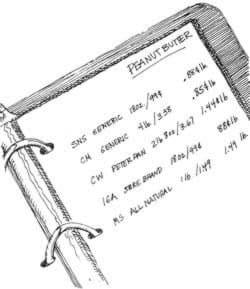
I began by writing down prices on sale flyers and from my grocery slips. I made a few trips to compare prices of specific items. It quickly became evident that not every sale was really a sale. But when I did find a good buy, and I could verify it with months of records…what power! I could stock up with confidence.
At first you may think this is too much work and the idea of shopping at so many stores will be inconceivable. It will pay off. A good strategy is to shop at different stores each week of the month so that within a 30-day cycle you can hit them all. We have our shopping system down to once a month with only a few short trips to hit unbeatable sales.
[Keeping a price book] revolutionized our shopping strategy more than anything else we did. For the first time we had a feeling of control over our food budget.
[…]It might take you a total of five hours to make up a price book for comparison shopping, but after several years of supermarket excursions, you may discover that your hourly “pay” for those five hours was over $1,000.

Grocery Price Comparison Spreadsheet
When Dacyczyn first published this technique nearly twenty years ago, personal computers were not ubiquitous. But in the Internet Age, it seems a little old-fashioned to keep a paper-based price book. As much as I love notebooks, I’d rather keep my data in a spreadsheet where it’s easy to search and sort. I found two Excel-based price books: one at Cheap Cooking and a more elaborate version at An Uncommon Way to Wealth.
If you’d rather start a paper-based price book, OrganizedHome.Com has a free printable price book page. (Though, to be honest, you’re probably better off just using notebook paper!)
For more information on grocery price books check out:
- No Credit Needed: Grocery price book
- The Dollar Stretcher: A grocery pricebook and Price book 101
- Fractured Frugal Friends: The price book
I already know several powerful grocery shopping tricks — shop on a full stomach, always use a list, use coupons, shop alone — but the grocery price book is new to me. It sounds intriguing, but I worry that it would be too much effort. Do you keep a price book? How has it worked for you? Any hints or tips?
[The Complete Tightwad Gazette: The price book, pp. 33-34, 123, 322-323]
Become A Money Boss And Join 15,000 Others
Subscribe to the GRS Insider (FREE) and we’ll give you a copy of the Money Boss Manifesto (also FREE)

There are 61 comments to "Use a Grocery Price Book to Slash Your Food Spending".
I don’t keep a price book, mainly because I’m in the process of changing so much of my life right now.
My parents were once-a-month warehouse club shoppers. The only thing they never “stocked up on” was milk. Everything else was bought usually once per month, or less. Lots of processed foods and very few fruits and vegetables.
This taught me two very bad habits: eating things that were bad for me, plus the bad habit of stockpiling.
When I moved out, I would regularly stockpile food when I found it on sale. The problem was, I didn’t have the ROOM to do that. Also, invariably, the food I stockpiled was the kind that COULD be stockpiled — processed food that didn’t spoil because of preservatives and high salt content.
As a part of my current diet / life improvement, I am changing all of that. I am shopping every other week. I am buying fruits and vegetables. I am getting rid of my kitchen stockpiles (with the exception of my hurricane preparedness kit). I am choosing less processed foods for myself.
Another part of my diet that doesn’t lend itself to this particular hack is the fact that I am trying to shop organic when I can, and cheaply when I can’t. I am also trying to cut down on my gas usage. This means I shop two places — Whole Foods and Wal-Mart. Running around town to get the best deal, even over the course of a month, wastes more gas than visiting WF near my work and WM near my home.
That’s my $0.02.
While I agree with you, Cliff, that running around town isn’t worth it, many retailers, including Wal-Mart, will honor the sale prices of other stores that they consider to be “competition.”
Even though I very rarely do my grocery shopping other than at Wal-Mart, I still check the sale flyers on the websites of Wal-Mart’s competitors.
I use the price book spreadsheet from An Uncommon Way to Wealth. It’s not perfect, but it does the job.
My all-time favorite price book tool was Price-It, which I no longer own and is no longer available. It was Palm-based and had a desktop component. Loved it. Made managing a price book almost painless.
Since I started using one again, I’m becoming more familiar with true bargains. Thus my grocery shopping is becoming more focused.
When building a price book, it’s important not to do everything at one time. Every week I pick two or three products, and I note their prices in the stores I visit. After a while, you’re just updating two or three items per week.
I’d much rather use a price book than cut coupons.
I use a spreadsheet that I made — I update it when I see new prices, but mostly just the slow building it allowed me to see patterns and know true sales. Now that I know generic beans best price is $.50, I don’t always need to check my price book. But for more rare things, I probably would want to check, if I could, that dried cherries are still the one fruit Trader Joe’s has cheaper than Costco.
I print out the sheet or two of the spreadsheet so I can refer to is when shopping, and carry a pencil to update in the store the prices of anything I chose not to buy. I update the spreadsheet itself when I’m back home with the print-out and receipt.
It’s pretty easy to compare some things, more difficult for others. I can compare two cans of beans, but it takes more planning and effort to compare dried beans that I cook to the canned version.
I don’t use coupons, but I rarely buy name brand either. Waiting until generics go on sale has been my best bargain, generally.
Your first commenter’s note was very interesting. I’ve had to work very hard to change my husband’s habit of stockpiling.
Stockpiling when you’re in debt is incredibly short sighted – yes, you may save a few dollars buying 3 things and getting 1 free, but if you pay interest on credit that few dollars is quickly lost.
I wish I could do this. But like the first commenter, I cannot do this and also eat the things I truly want to eat.
I tracked flyer prices on an excel sheet for products we bought often and it really helped me bring down the spending that little bit more. Using coupons and flyers, we had already slashed the cash spent so the additional savings was marginal.
What I found though, was that the labour of maintaining the file (4 store flyers a week x several staples)was just too great when adding in the increased attention to bank accounts, budgets, spending trackers, debt repayment plans. I just couldn’t keep up with the data.
As of Jan 1 2007, my wife and I have almost destroyed our debt and the remainder is not long for this world. We make good income but our expenses were frivolous. Your website and others have been super helpful with ideas and tools to make the job easier. I’ll tale a pass on this one though.
This seems very time consuming. In my opinion, one must find a balance between finding ways to save money and finding ways to make money. I have a tendency to focus on saving money. Since I do that by default, the past few years I’ve made an effort to focus more on making money. As a result, I’ve paid off all debt including the mortgages on two properties. I never would have done that making spreadsheets on the best grocery prices.
I’ve been doing a partial version of this for about a year…keeping the prices of our most common purchases in my head so I will know if I’m looking at a good bargain or not. I would like to make it formal and extend it to less-often purchases, but didn’t want to make my own spreadsheet. This article is a push to give it a try—perhaps with the price book spreadsheets that others have written.
As for the issue of fresh vegetables…a price book system will help with this also if you shop in more than one place. Knowing how much red peppers (our favorite) cost per pound helps me decide whether to buy them today at Store A or tomorrow at Store B.
We’ve found that it pays to shop at three (or four) stores per week. We like to get our vegetables and meat fresh so we go to the store 2-3 times a week anyway. (They are all near home or work.) I make sure to go to each store that has some of our staples on sale. (I check out the on-sale flyers ON-LINE on Monday), This way I don’t miss sales.
The price book should make it easier to buy everything we need at the lowest prices (not just on-sale). I think it will really help in the process of squeezing the most out of our food budget.
Thanks for reminding us about this.
I think I’d have to pass on this one. I absolutely detest doing the grocery shopping, so I’m not willing to drive all over town and waste my time and physical and mental energy for the chance to save 50 cents on a bag of potato chips here and a dollar off of laundry detergent there. We have our grocery budget and I write my meal plans and shopping list around that number. Things cost what they cost, to me at least.
I am a very organized shopper because of the fact that I hate it so much, so not only do I make our meal plans a week in advance and shop with a list, my list is written in the order that the store is laid out so there is no going back and forth for missed items. This allows me to do the food shopping for the entire week in about 20-30 minutes. When we moved and switched grocery store chains, it took me months to get used to the new layout. I definitely would not want to do that several times a year.
Time is money. And personally my Saturday is worth a lot more than a few bucks off the grocery bill.
I think it’s a misconception that one has to drive around to a whole bunch of stores in one day just to save a few dollars on the grocery bill. You can check out sites such as Money Saving Mom and the Krazy Coupon Lady that explain how to really save on your grocery bill. And for people who need to crack down on their budget, those dollars add up!
It sounds like you have your grocery system down pat. Kudos for you! I’m working on doing the same thing by making a price book. I think it’s going to help me out a lot by knowing my area’s store sales cycle, and I just can’t keep all of that info in my head.
Wow, I guess it’s just me then. I have long been a fan of the price book, and find that mine saves me money. BUT I’m a suburban mom so I have both time to comparison shop AND fairly quick access to a large variety of food sources. I also have a family that eats a lot – this strategy may just be one of those that works better for SAHMs than busy singles.
One thing I WILL say tho – I use this in concert with an inventory in Excel of ALL the food in the house. (No, it’s not as hard to maintain as you think – simply enter what got used after each meal as part of your normal cleanup routine, takes about a minute.) So I’m never in danger of stockpiling too much. It also helps me waste less food – I never have things expire or go bad in the back of the fridge right now.
As far as not being able to do price book for healthy foods, why not? We are very much hippie-granola family, and I find a price book is ESPECIALLY helpful for getting the best bargains. ‘Chickpeas, Dried – $0.50/lb food co-op’ is just as easy an entry to make as ‘Pudding packs – $1.39 Wal-Mart’ or whatever. For produce it can really help also to note the season – eating seasonally is much cheaper. I can buy horrible limp zucchini for $2 right now in May or I can wait until August and enter ‘Zucchini – 3/$1 farmer’s market’.
Denise, I would love to know more about your food inventory maintenance system. I can record all of the food I have at one time, but keeping up with the inflow and outflow is beyond me. It sounds like you even keep a running inventory of your refrigerator? Sounds wonderful.
I’ve simplified my food shopping and spend about $100/month
Costco: Chicken breasts and italian sausage. I spend $40 between the two, freeze individual servings and have enough meat for the month. I rarely buy anything else here except for the occasional brick of Tillamook cheddar because the price is so incredible.
Target: For name brand things (I can’t live without DeliciousFresca) and paper products/cleaning supplies etc. These are considerably cheaper than at a standard grocery store and since I can’t stomach WalMart, Target is fabulous. I only shop here about once a month
Trader Joe’s: This is where I do my weekly shopping. It’s delicious, high quality and CHEAP. I avoid prepackaged foods (except for the $1.50 enchiladas!) and stick to staples.
When people overspend at the grocery store, it’s because they are paying for options. I spend less because I decide when I’m shopping whether I’m going to have pork tenderloin or chicken breasts; cheddar or brie. Rather than making the choice when I get home ($100 later) I make the choice at the store!
Like the first commenter, I also keep processed foods to a minimum, but a system like this can still be useful. Even though I buy fresh foods almost exclusively, if I am willing to be flexible with my meals, I can save a lot. I plan my menu for the week around what is on sale. By knowing my prices, I can judge what is and is not a deal, and I can work with those things that are. Vegetables go on sale (at least they do here – even Whole Foods has store specials) – and those that are, are incorporated heavily into my salads and are worked into great side dishes. If you are willing to freeze meats, you can stockpile. If you do not want to freeze, again, just plan your meals around the sales. It might seem like a sacrifice at first, but the amount you save over time is well worth it.
For any Palm users, I recommend a great little app called “HandyShopper”. It’s basically a shopping list, but it has lots of features & is well suited to using as a “price book”. It allows you to set different prices for each item for all the stores you regularly shop at, and it also does all sorts of cool things like arranging the items by aisle (with customised settings for each different shop, so shopping is much more efficient!). It is also good to use for other kinds of lists, like gifts, or packing lists for trips. Some even use it as their main to-do list, as it has priorities, alarms etc. I use it all the time for my shopping list – I’m pretty disorganised so it really helps me! It has a special “one-handed” mode for when you are in the shop, so there’s no fiddling around with tiny touch screen buttons whilst trying to push a shopping trolley around! Once you’ve put most of your regular items in, it’s fairly low maintenance; you quickly build up a pretty long list covering most things you buy, so all you do to make a list is write the first few letters of the item & it’ll find it for you, and if its not already there you can add it with only a few more taps of the stylus.
I had been putting some prices in, but after reading this article I’ll have to remember to add in prices more often. I’m a sucker for a bargain, but being rather forgetful doesn’t help in working out whether something really is a bargain or not!
In reply to Cliff, who said it’s hard to stockpile & eat healthily – that depends what you buy! I buy a lot of dried & tinned beans & lentils, various types of flour, dried fruit, nuts, seeds, frozen veg, tinned tomatoes (which are one of the few vegetables that are still pretty nutritious when tinned) etc, that are all pretty healthy. Obviously most fruit & veg is not suitable for stockpiling, so I buy that fresh, but I still look out for anything that’s on special offer!
I think that the idea of a price book is great, but like several other folks who left a comment, I know that I’ll never use it in the format that was presented (i.e. notepad or spreadsheet).
I would be interested in seeing grocery stores help out their frequent shoppers by sharing some of the information they gather for their internal use.
I live in Cincinnati, home to Kroger (www.thekrogerco.com) is headquartered. Kroger stores use a Plus Card system which is free to customers and gives customers the special sale prices each week. I don’t like the idea of them tracking my purchasing habits, so I shop elsewhere, but I think I might change my mind if Kroger would use the information they gather about my purchasing habits and share a little of it with me.
The ability to create an online shopping list of the items I purchase regularly, with a notation of the average/high/low unit prices I’ve paid in the past would really help me to see if I’m really getting a good deal. I’d be much more willing to help them with their tracking of my spending if they’d be willing to share the information with me. Until something like this comes along, I’ll just buy what I need when I need it at the store that will give me the sale price without mandatory tracking of my spending.
The idea of using a log appeals to me for certain items that I use a lot, such as berries and bread. I agree that it would be cumbersome to track most food purchases that way, but for frequently used items that vary widely in price, it could be very useful.
And like Cliff, I’ve been trying to move away from processed foods toward more organic and generally healthful foods, but this doesn’t deter me from stockpiling certain things. When berries and some other fruits are on sale, I buy several tubs and then freeze most of them. (I wash them, then place them on layers of wax paper inside freezer containers, then freeze.) This allows me to stockpile healthful foods and use them for smoothies (instead of ice cubes) or thaw them out for cereal.
I agree that most processed goods aren’t really nutritionally worth stockpiling, but I make exceptions for low-sodium chicken and beef broth, tomato sauce, Kashi bars, and albacore tuna (but watch the methylmercury!).
I’ve been using a pricebook for a couple of years now. Yes, it takes a little work to set up, but after a while it’s only as much work as you want it to be. There’s no rule that you have to include every single item you ever buy. I tend to concentrate on those items that are likely to appear as “loss leader” sales, such as meat, butter, and orange juice, and also nonperishables such as tuna, pasta, canned tomatoes and dried beans. (Loss leaders are the items in big print on the front of the supermarket flyer, being sold super-cheap in order to get people in the door.)
My list is a simple table in Word with four columns: the name of the item, the price, exact brand / size info, and the store name. I also put a letter “s” after the price if it was a sale, so that I know not to expect that all the time. I print the table out once or twice a year at most (it’s around four pages) and make handwritten updates from time to time in between, on blank lines that I leave for this purpose.
I do not bother to check every single item every time I shop! Sometimes, indeed, things just cost what they cost, as poster #9 said. Also, I have basic benchmarks for a lot of staples in my head by now. So, for instance, if I’m doing my big monthly shopping and the cheapest canned tomatoes available are $1.29, I’ll only buy as many cans as I need right away, but if they’re 0.69 I’ll buy a dozen or more. Most of the time, of course, it’s sufficient just to buy the generic.
I find the book quite useful if I’m in some store where I don’t typically buy food (e.g. Wal-Mart or equivalent). There you often don’t see as wide a range of brands, so it’s harder to gauge what is a good price. The price list helps me avoid springing for phony bargains in this situation. It would probably be good in warehouse stores too, where I imagine the package sizes are different from what you see in supermarkets, making comparisons harder.
Another good thing about the book: it helps me keep various cuts of meat straight. Eye of round? Top round? Chuck roast? Blade steak? Flank steak? It’s important to compare apples to apples. The book is a simple way to remember that eye of round is our preferred cut for roasts, so I don’t even bother tracking prices on other types.
I appreciate the concern of several posters that the time and money expended maintaining the book and running around to multiple stores outweigh the savings. Actually, though, I find the book often reduces the number of trips I make. The reason? Without the book, I’d be likely to run out to a new store and stock up on chicken breasts, say, just because the flyer said “TERRIFIC deal! 3.99/lb!!!!” With my book, I know that they’re likely to show up soon for 1.99/lb at some store I shop at regularly anyhow.
Of course, some common sense is required to determine how far you’re willing to travel to save a given amount of money.
Yes, this system clearly works best with nonperishable or freezable items. Still, as poster #13 said, plenty of these items are good for you. In our house we eat extremely few prepared foods, but it’s surprising how many good deals you can find on the staples if you pay attention.
I just started a couple of months ago. I started just by entering the prices from my recent grocery store receipts in a spreadsheet. I did one time note the price of a bunch of foods at another store (discreetly so they wouldn’t throw me out).
For the most part, I just shop where the best deal has been in the past for the foods on my list, and I notice if there are sales. I don’t usually take my price list with me, I just compare my receipt against my spreadsheet when I get home.
Several of the things I buy regularly are between $.50 and $1 different at the stores I frequent most. So with a decent amount of care I might be ahead by $4-6 by shopping at the store that fits my shopping list best.
Some things have really surprised me. I expected Walgreen’s to be better on most medicine products. But they consistently have the worst price in town (of the places I shop) for Prilosec. I’ve found the same for other over-the-counter stuff. Sometimes their sale price is a real winner, but often their regular price is totally non-competitive. They do sometimes have selection I can’t find at other places.
I don’t use a price book, because I usually have a pretty good memory, but I do the same thing as you do mentally. And when I get a good price, I make sure I buy enough to last until the next time it is on sale: Frozen veggies, canned veggies, boxed sides, and meats. I have been known to buy up to 12 lbs of boneless skinless chicken breasts at $1.99 a lb or almost as much split chicken breasts at .99/lb to freeze and keep/use until it is on sale again.
By doing this, sale items make up over 90% of my grocery spending, as I don’t need the items that are not on sale.
Using the price book or your memory both work well, but remember to buy enough to last you until the next sale. Not enough to last through a nuclear winter, just enough until the next sale 😉
One thing that I don’t think I made clear in my initial post is that I don’t have the SPACE for stockpiling most items. My freezer space is limited, so cupboard storage is all the stockpiling I can do. I’m single, and I don’t go through flour, pasta, rice, or any normal staples very frequently at all. Outside of those items, the only thing to stockpile in the cupboard is processed foods.
We use this strategy and it works out pretty well. We’re able to stock up when prices are low on an item and avoid buying certain things when they’re not on sale.
-limeade
I haven’t had a chance to start using this regularly (in the process of moving so I was minimizing my purchases and trying to clear out as much food as possible), but this website looks pretty promising.
http://www.mygrocerydeals.com/
A Price Book is a nice idea. I do the same as JohnK. Time seems to be an issue with a 4 and 7 year old. We seem to buy the same items most of the time so I have a good idea of the “normal” price is on the staple items that we purchase.
I use the chicken example again. This week our local store (Giant) has boneless chicken
BOGO at $4.99lb! We were at the store during peak Sunday hours and we saw several people buy the chicken even though the same bonless chicken will probably sell for $1.89/lb in a week.
Another thing I have notice is our local grocery store will increase the normal price on an item and the following week will put a “NEW LOW PRICE” sticker on the item. The item is a frequent “loss leader”, but if you don’t follow the sale cycle you’ll pay alot more….
I am slowly teaching my wife about tracking the prices…. maybe a price would help her….
I use My Grocery Deals in conjunction with my price book. Glad you mentioned it, amm99.
Thanks for the comment about my spreadsheet, Virginia. I’m still trying to convince my wife to use it, but she doesn’t much like it. So, congrats to those who actually use it and save money.
The first year we were married, my wife maintained a spreadsheet of grocery items bought with their prices. Since then, I believe my wife keeps a Grocery Price Book completely in her HEAD! Pretty amazing, if you ask me.
I started to keep track of prices of foods we commonly buy from shopping receipts in an excel sheet. We will often just buy the same brands without shopping for the best price so I wanted to get an idea of what we were spending food money on. I don’t include fresh produce or meat because the prices seem to change so much, and we also started getting a box of fruit and veg delivered which is a fixed price each week. I slowly added in most of our staples over a few months, and also where they were bought. I wasn’t even sure it was very useful, but since we’ve been working up to seriously attacking our debt, it’s been really helpful for grocery shopping.
We decide on what we’ll eat that week, as well as what staples we’re out of (including non-food items like toilet rolls). Then we make a list and note down the prices at the shop we’ll be going to. That way we have an idea of what our bill is going to be (and if we’re on a really tight budget, it will shape what we’ll be buying and eating that week). Then at the shop we can compare prices and spot specials or price increases. If we buy a new brand or item we just add it in to the spreadsheet when we’re adding the receipt to our budget program.
It does help that the 3 main supermarket chains here often have mostly the same prices on non-generic brands. It’s really only their brands which can be very different in price.
I don’t use a price book but I do like to know what sales are good ones for our commonly bought items (diapers, soda, etc.). I’ve been thinking of making a little list of pricepoints for things I could stock up on when I see a deal (diapers, wipes, lotions, sunscreen, tp, etc.). I thought about this when I bought some cold medicine “on sale” at the grocery store and then happened to see the same stuff at another store for two dollars less the next day. I’m a sucker for a sale so I’d like to know whether they are actually good deals or not.
I have a really weird problem, I don’t get the flyers, ever! and it makes it hard to plan ahead. I’ve found some of them on line but not all of them. A bigger problem was the local discounter closed shop and it threw my shopping planning off as I had to find another store. Now I have to plan on a twice a month trip over the Lidls, they have same stuff slightly better prices. Over all I keep the prices in my head and update my price book when I think of it. for sure being aware of prices can save you alot, or with food inflation keep your food bill from rising too fast.
I want to thank you for many reasons for writing this post, not the least of which is now I know how to pronounce “Dacyczyn.”
Thank you for the excellent resources and ideas for pricebook – it is going to be my project for the next week or so. The blogs will have to wait :), they don’t make me near as much money!
I am getting ready to start a pricebook but am contemplating whether to comparison shop more or stick to my usual stores. I strictly buy my produce at a certain store and tend to buy my groceries and household products at the same place every 2-3 weeks. Like other posters, I also don’t have the option of stockpiling most things. It’s interesting to try out.
To save money on great, locally grown organic produce, consider joining a food co-op or a CSA (community sponsored agriculture). Since a huge part of food prices is linked to fuel prices, eating locally grown food is a great way to save money while supporting local farmers. My farmer lives a few hours outside New York city. I pay a lump sum to be a member for the year, and every week from June through December I get three plastic grocery sacks full of fresh produce, fruit, fresh herbs. They were picked the day before and taste spectacular. Pesticide free. There are three “cons” to joining a CSA: 1) you have to be available every week for the pickup – in my case every Wednesday between 4pm and 7pm at a nearby school. If your work hours are really unpredictable this can be tough. 2) You get a share of what grows – if it’s a bad year you get less. But if it’s a good year you get more! The price is fixed – makes it easier to budget. 3) You don’t choose the vegetables like you would in a store – you show up and get a share of that week’s yield – for example, two squash, one broccoli, one bowlful of salad greens, one handful of fresh parsley etc.
It requires rethinking family meal planning, but you end up eating seasonally which is the best thing anyway. I rely heavily on recipes from the cookbook Moosewood Cooks at Home because most of the recipes are seasonal or easily allow substitution of one type of vegetable for another.
I usually shop at the supermarket once a week the day after my CSA pickup so as to make the best use of the produce that came in. In the fall and winter we get so many root vegetables that I make big pots of soup and freeze half. By January when nothing grows in my area, I’ve got a freezer full of delicious healthy organic homemade soups to get me through the worst of winter.
Plus my freezer’s stocked in case a friend gets sick.
happy eating!
The price sheet saved me a tremendous amount of time once I used it about 3 times…..Groceries are one of the few “fungible” areas of your budget every two weeks, so I knew I HAD to do this to get a sense of monetary peace. and it worked!
I use an excel sheet — the most important thing to compare is unit prices.
After a while, it was easy to see that a particular box of wheat crackers from Wal-Mart were .14 per unit, while the same crackers from Nabisco were .32 per unit.
Now I always buy the same things, no big hassle checking prices.
(And I know generic beans used to be .50 per 15 ounce can, and are now .78 per 15 ounce can.)
It’s cool — JUST DO IT.
p.s. I use the money I save to go out to dinner sometimes!!!
This same concept works well with larger purchases as well. I have a notebook that I carry in my purse and I have a page for each major ($50+) purchase that I plan to make in the next 3-6 months or so. Then if I’m at a store, I note down the prices of the different brands and options I’m considering. So if there’s a sale, I’ll know whether its really a good deal.
We have created a free website that helps users track grocery unit prices paid by item and also shows which items have increased in unit price and units purchased. Among the features of the website are:
1). A grocery list that shows the lowest unit price paid to facilitate comparison between the current store unit price and previous unit prices paid. Very helpful at the store!
2). Analysis on spending trends to provide a list of grocery items where unit prices have increased and total units purchased have increased, among other areas. Helpful at home for figuring out where to cut costs and why the bill is increasing.
3). Item detail and trend analysis for additional detail.
The site is groceryhop.com
Please let us know what you think!
For those of you with iPhones, you can use the Evernote app (free!) to sync your price list with your phone. Spreadsheets aren’t supported, but still pretty cool!
Miss Dipsy mentioned a Palm app that acts as a shopping list, which can function as a price book. We went one step further and wrote an Android based app called PriceBookDB.
It lets you track items, prices, and stores, over time to determine the best time to buy any particular item. It seems that most people buy the same products week in and week out, such as milk, bread, meat, and produce. They also buy the same monthly items, Toilet Paper, cleaning supplies, soap, etc. All of these items can be tracked, sorted, and categorized.
We let you create basic shopping list, which can morph into exactly the brands that you buy. We let you share your shopping lists with your spouse’s phone, or a web site. You can sync shopping lists, check items off, and analyze your buying habits.
To top it all off, we crowd-source all of the users data, so that, if you want, you can see all of the item-price-date-store info that other shoppers have entered, in your area, so that you don’t have to do all of the work.
It’s a neat app, and we’re pretty proud of it. We’re working on it almost every day to make it better. If you have an Android smart phone, we would love for you to download it, try it out, rate it, and leave a comment. You can visit our web site http://www.pricebookdb.com
You can download it from the Android Marketplace, for free, here:
http://market.android.com/search?q=pricebookdb
We really hope you enjoy it.
Save well and prosper!
In our area, its generally assumed that Aldi & Save-A-Lot have the lowest prices around. So I just went to those stores, wrote down the prices & sizes for the items I buy, and use those as my price-book. When I see a sale at the main chains, I will compare it to the list. If its lower, then it truly is a sale & I will buy at the lower price.
Since we only have 2 people, its a good way to save money. We cant stock up too much, but we can buy where the items are cheapest that week. It saves us hundreds of dollars a year, and took very little time to put together.
Interesting concept. I may have been doing this without writing it down. My method is to scan the Sunday papers and see who is running a sale on the items that I buy the most of. Then, I shop there for those items. IF, it’s within a meaningful driving distance.
As a senior with still young children (expensive ones at that)…. I do keep a price book. Here where I live (Montreal), large stores are plentiful and they compete via flyers. Even drug stores compete. So yes, prices vary a great deal from one store to another. However, I like to weigh in the cost of traveling (gas), for all the specials. If I’m going to spend $10 of gas running around… is it really worth it?
We got a copy of the “Tightwad Gazette” and it does have some useful tips that saves cash over the long term (small chunks here and there DO add up).
I just came across a power shopping strategy where you wait for sales on your most used items and then buy a lot with coupons to stock up. Really simple to apply this strategy. I’ll try and write a post about it on my blog (after the 50 other things I want to write about – hee hee)
Anyway, I like your get rich slowly theme. It keeps people from borrowing money thinking it will get them rich fast. Learn, become wealthy in the mind, and riches can be yours anytime because you know how to be rich.
Thanks for allowing me to vent my 2 cents.
I am 27, started cutting coupons early 20s.
Some habits to get into:
Sunday is coupon cutting day, it is also the day I go online and review weekly ads for Walgreens, target, and Publix.
I write down what I need and then review foods that are on sale.
So here is what it looks like: Publix buys;
Carrots- $1.45 small bag (otherwise the rest will spoil)
Large Publix salad in a bag $4.00 (always get the salads from the bag they are the freshest)
Cucumbers 2 for $1.00
Okra .88 cents
Yellow squash 1.85
In season fruits and vegetables I try to avoid unless they are on sale, like corn, apples, and cherries/strawberries.
—Thats it for produce.
I cut coupons for salad dressings and can usually buy 2 8oz bottles for .99 cents w/ coupon or bogo.
Bacon BITS!! love em ( just ate a salad lol) 1.85
Cheese, buy block cheese generic, it’s usually under 3.00 and will last a while if you pull from the back.
Always always look for buy 1 get 1 w/ coupon, you will save ALOT.
Just bought tombstone pizza, bogo w/ a 1.00 off coupon, so it cost 4.00.
Frozen skillet dinners, bogo at 4.99
raman noodles 6 for 1.00
milk, get whats on sale always! had 2.00 coupons for lactaid so got 2 for .18 cents each! 🙂 Loooove it!
Air freshner with coupon cost me .39 cents
Usually at Walgreens I buy clearance toothpaste and shampoo’s, razors, mouthwash, soaps, handsoaps, toothbrush, deoderants, and I use my coupons, so I get these items for around 30-80 cents and I stock up. I have a huge bucket under the sink full of those items.
Target I check the weekly ads, and found their corn is cheaper then publix, .25 cents each vs, 5 for 2.00 at publix.
I like going to target for condiments and canned goods, they have a lot of these items for around 2.19 and I use 1.00 coupons which adds up to savings!
I take a sunday to have a little fun with this stuff because it’s my rush for the week, nothing feels better knowing you saved a ton of money.
I was a bit shocked when I calculated how much I spend on food. I like to think I’m thrifty in my food spending habits—I cook a lot and usually eat out only on the weekends—but I don’t usually add up my food costs and rarely make serious estimates for food spending when I make a budget, instead assuming that I’ll manage to make do with whatever’s left after I cut a check for rent, buy a bus pass, and pay my utility bills. Thanks for the information,,GBU
I have not checked in here for a while since I thought it
was getting boring, but the last several posts are great quality so I guess I’ll add you
back to my everyday bloglist. You deserve it my friend 🙂