What happens if the stock market crashes? Here’s what to do

Can you feel it? There’s panic in the streets! We’re in the middle of a stock market crash and the hysteria is starting again. As I write this, the S&P 500 is down six percent today — and 17.3% off its record high of 3386.15 on February 19th.
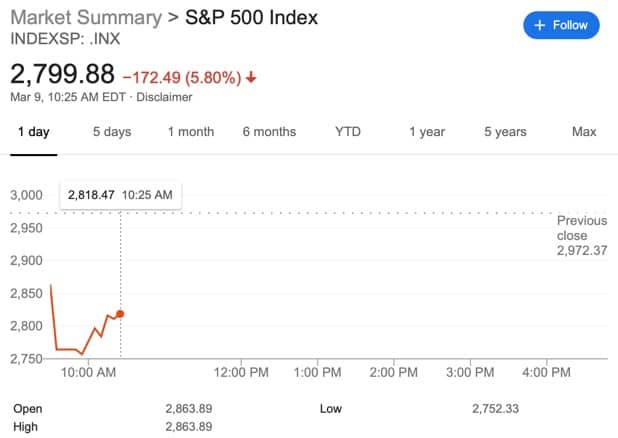
Media outlets everywhere are sharing panicked headlines.
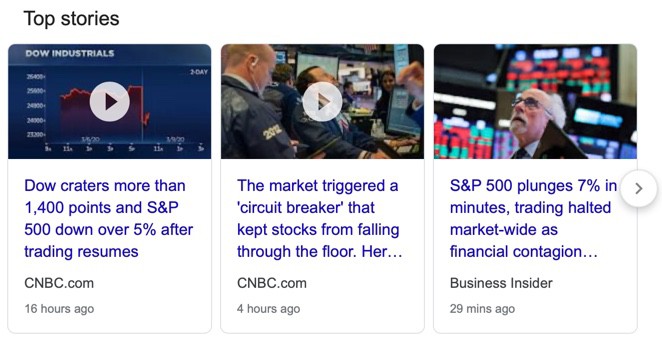
All over the TV and internet, other financial reporters are filing similar stories. And why not? This stuff sells. It’s the financial equivalent of the old reporter’s adage: “If it bleeds, it leads.”
Here’s the top story at USA Today at this very moment:
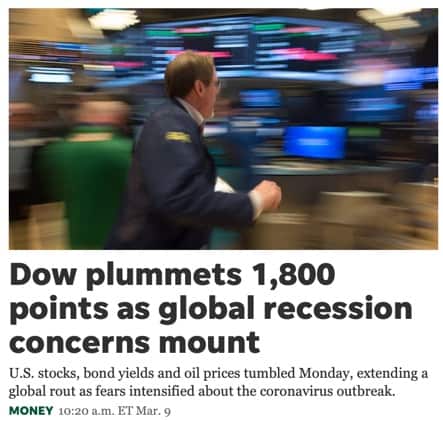
But here’s the thing: To succeed at investing, you have to pull yourself away from the financial news. You have to ignore it. All it’ll do is make you crazy.
Note: This is an updated version of the article I publish whenever the stock market crashes. I last shared it on 21 January 2016. Some comments are from previous versions of the piece.
Bad Behavior
The sad truth is that people tend to pour money into stocks during bull markets — after the stocks have been rising for some time. Speculators pile on, afraid to miss out. Then they panic and bail out after during a stock market crash. By buying high and selling low, they lose a lot.
It’s often small individual investors like you and me who make these mistakes. During the Great Recession, one Get Rich Slowly reader shared the following story:
“I’m in the [financial] industry…I can tell you now that when the markets tanked during October [2008], people with less than (approximately) 100k behaved significantly different from investors with 100k+ in the market. Also, people who did not have an emergency fund behaved significantly different than those who did, generally to their own detriment.
“These actions lead me to believe that people with substantial assets tend to ride out the market and not worry about short-term fluctuations, whereas people with smaller amounts of assets lock in losses by removing assets from the market at poor times. Then, when/if they get back in, they’ve missed out on several days of big gains…
“As it was happening I was shocked by the clear income demarcation that seemed to separate rational behavior from irrational behavior. Do small investors make behavioral mistakes that keep them from becoming wealthy?“
Instead of selling during a downturn, it’s better to buck the trend. Follow the advice of billionaire Warren Buffett, the world’s greatest investor: “Be fearful when others are greedy, and be greedy when others are fearful.“
In his 1997 letter to Berkshire Hathaway shareholders, Buffett made a brilliant analogy: “If you plan to eat hamburgers throughout your life and are not a cattle producer, should you wish for higher or lower prices for beef?” You want lower prices, of course: If you’re going to eat lots of burgers over the next 30 years, you want to buy them cheap.
Buffett completes his analogy by asking, “If you expect to be a net saver during the next five years, should you hope for a higher or lower stock market during that period?”
Even though they’re decades away from retirement, most investors get excited when stock prices rise (and panic when they fall). Buffett points out that this is the equivalent of rejoicing because they’re paying more for hamburgers, which doesn’t make any sense: “Only those who will [sell] in the near future should be happy at seeing stocks rise.” He’s driving home the age-old wisdom to buy low and sell high.
Doing this can be tough. For one thing, it goes against your gut. During a stock market crash, the last thing you want to do is buy more. Besides, how do you know the market is near its peak or its bottom? The truth is you don’t. The best solution is to make regular, planned investments — no matter whether the market is high or low.
Meanwhile, ignore the financial news.
No News is Good News
The mass media is in the business of selling news, and to do that, they sensationalize it. Fueled by the over-eager reporting, irrational exuberance can quickly turn to pervasive gloom. Neither state of mind makes sense. They’re both extremes that lead investors to make poor choices.
For example, I know a couple of people who “invested” in Bitcoin when it was all over the news. Now they wish they hadn’t but they bought into the hype. My brother lost two homes to foreclosure and declared bankruptcy because he bought into the U.S. housing bubble during the mid 2000s.
Meanwhile, the people I know who ignore financial tend to prosper.
The May 2008 issue of the AAII Journal featured an article entitled “The Stock Market and the Media: Turn It On, But Tune It Out” in which author Dick Davis argued that daily market movement is often illogical and/or arbitrary. Except for obvious catalysts — military coups, natural disasters, the coronavirus — nobody knows what makes the market move on any given day. Short-term changes appear random. Besides, as we just learned from Warren Buffett, they aren’t really relevant if you have a long-term investment horizon (which is probably the case for most of you).
To the long-term investor, daily market movements are mostly noise and filler. “What’s important is repetition or the lack of it,” Davis writes. A trendline is more useful than a datapoint.
“I believe one of the worst things that can happen to a long-term investor is to be instantly and totally informed about his stock. In most cases, spot news fades into irrelevance over time…Big market moves may be inexplicable, but a long-term or dollar-cost averaging approach precludes the need for explanations.”
You can watch the daily investment news, but don’t let it sway your decisions. “Focus on the long term,” Davis writes, “and you can ignore the media’s distortions.”
Davis isn’t the only one to believe that no news is good news. Research backs him up. In Why Smart People Make Big Money Mistakes (and How to Correct Them), the authors cite a Harvard study of investment habits. The results?
“Investors who received no news performed better than those who received a constant stream of information, good or bad. In fact, among investors who were trading [a volatile stock], those who remained in the dark earned more than twice as much money as those whose trades were influenced by the media.”
Though it may seem reckless to ignore financial news, the book argues that it’s not: “Long-term investors need not concern themselves with yesterday’s closing price or tomorrow’s quarterly earnings reports.” Make your decisions based on your personal financial goals and a pre-determined investment strategy, not on whether the market jumped or dropped yesterday.
“But This Time Is Different!”
Whenever the stock market crashes, there are folks who cry, “This time is different!” This time the market won’t recover. This time the economy is going to be mired in a morass for years. Or decades. Or forever. So far, “this time” has never been different.
But I’ll admit: This time does feel a little different. Yes, I believe that much of this panic is just that — panic. And I expect that, overall, this downturn will mirror previous downturns. That said, the coronavirus is real. Despite the admonitions of certain self-proclaimed experts, the coronavirus is not the flu. It’s far deadlier. And even when it’s not fatal, it can be debilitating. (Did you know that 5% of cases in China require artificial respiration? Another 15% require oxygen therapy? That’s not the flu.)
The coronavirus is having real effects on the global economy. And those effects may linger for months — or years.
Take Apple, for instance. One of the world’s largest companies, Apple’s profits depend on a regular product cycle, one that routinely introduces updates to existing gadgets while occasionally introducing new ones. But the coronavirus is going to delay many of its planned 2020 announcements. Plus, it’s gumming up production of existing items. The bottom line? Apple’s numbers are going to be a mess this year.
Apple isn’t alone. The coronavirus is wreaking havoc with the global economy — and I suspect this is just the beginning.
- Italy is restricting travel and canceling all public events.
- The city of Austin, Texas canceled the South by Southwest festival.
- Sporting events around the world have been affected. Games have been postponed or canceled. Some are being played without spectators. And even the summer Olympics — scheduled to start on July 24th — are in danger of being delayed.
Here in Portland, we’ve had the coronavirus for about ten days now. The first diagnosed case came from a person employed at a school just five miles from our house. This has caused panicked runs on Costco and Wal-Mart.

Yesterday, Kim and I attended two crowded events: a Broadway musical (Frozen) and a Portland Timbers soccer match. Both had light attendance. (The official Timbers stats show a max-capacity crowd of 25,218 but that’s bullshit. There were empty seats all around.)
All this is to say: The coronavirus has already affected the national economy, and it’s only going to get worse. Your best defense? An ongoing campaign to develop a strong personal economy.
The National Economy vs. Your Personal Economy
Obviously, the national economic situation affects our personal financial decisions to some degree.
When unemployment soars, it’s important to maintain an adequate emergency savings and to limit your use of debt. When the stock market crashes, you need to understand your investment objectives, and how these relate to your risk tolerance and your investment timeline. (And when the stock market is up, you need to ask the same questions.)
Regardless the state of the national economy, ultimately you are responsible for your personal economy. A money boss is proactive, preparing for problems before they occur. When times are flush, you need to set something aside for the future. Then, when things turn dark and dismal, you’ll be better shielded from the slings and arrows of outrageous fortune.
A strong personal economy is built on personal finance fundamentals such as these:
- Clear financial goals. You need to know why you’re earning and saving money. Where do you want to be in five years? Ten? How do you want to get there?
- An adequate emergency fund. Experts disagree on how big an emergency fund should be. Some say six months, some say twelve, and others say three. I say it should be large enough to let you sleep at night when the economy gets rocky. (And the best time to save is before you need the money.)
- Limited use of debt. If you use debt, use it wisely. A mortgage isn’t a bad thing, and neither are student loans. A car loan is borderline, though, and borrowing to buy a television is foolish. Use debt only when needed. If you suspect you may lose your job or encounter some other big life change, then get rid of debt completely.
- The practice of thrift. When your personal economy is good, it’s easy to get lulled into complacency. You start buying organic ketchup and eating in fancy restaurants. You take bigger vacations. But if you can master the art of frugality when times are fat, you’ll be better able to practice it when times are lean.
- Smart investing for the future. Lastly, invest wisely. Don’t let the news lead you to make emotional decisions. Buy low and sell high. If you weren’t willing to sell your investments when the Dow was near 30,000, then how in the world does it make sense to sell them when the Dow is near 25,000?
The foundation of a strong personal economy is education. To become a wise investor, you must be an educated investor. And you must recognize what you can and cannot control. The national (and global) economy affects your personal economy, but ultimately all you can control are your personal finances.
I’m overly fond of this analogy, so I’ll share it again: The national economy is like a river. Sometimes the water is still and deep. Sometimes the current is swift. Sometimes snags and rapids block the river. Your personal economy is like a boat on that river. Your goal is to reach the river’s mouth, and to do so you have to keep the boat in working order. You have to avoid the snags and rapids, which means advance preparation. Mostly, your trip down the river is pleasant. From time to time, though, things can get hairy. If you’re not careful, in fact, your boat can capsize. Through it all, the river flows in one direction — and daily, well-prepared sailors reach their destinations.
The Bottom Line
I know market downturns can be scary. But here’s the thing: If this volatility makes you nervous, if it causes you to make bad decisions, then maybe you’ve put too much money into the stock market. Volatility is one of the fundamental features of stocks.
On average, the stock market returns 10% per year (around 7% when adjusted for inflation). But average is not normal.
Recent history is typical. The following table shows the annual return for the S&P 500 over the past twenty years (not including dividends):
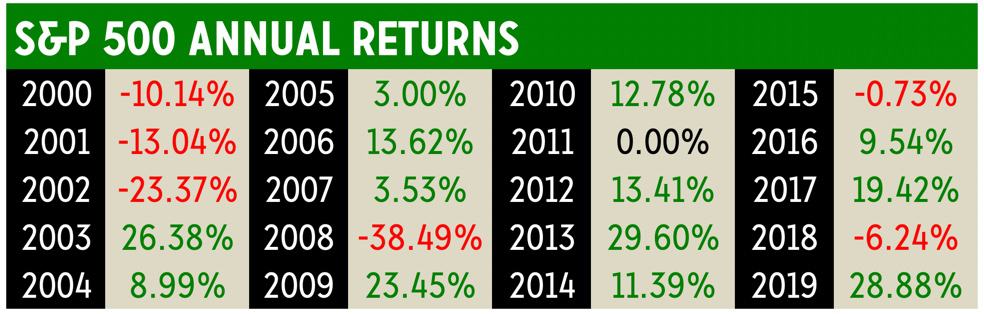
The S&P 500 earned an average annualized return of 6.06% for the twenty-year period ending in 2019. But zero of these years generated stock market returns close to the average for that time span. (2007 came closest to average with a return of 3.53% — still more than 2.50% off the average.)
Short-term market movements aren’t an accurate indicator of long-term performance. What a stock or fund did last year doesn’t tell you much about what it’ll do during the next decade.
In Benjamin Graham’s classic The Intelligent Investor, he writes:
“The investor with a portfolio of sound stocks should expect their prices to fluctuate and should neither be concerned by sizable declines nor become excited by sizable advances. He should always remember that market quotations are there for his convenience, either to be taken advantage of or to be ignored. He should never buy a stock because it has gone up or sell one because it has gone down. He would not be far wrong if this motto read more simply: “Never buy a stock immediately after a substantial rise or sell one immediately after a substantial drop.“
If you believe stock prices are still high, then steer clear of the market. If you think they’re low, then buy. And remember: Unless you sell your stocks, you haven’t lost anything at this point — it’s all on paper.
During the tech bubble of the late 1990s, I was part of an investment club. My friends and I chortled with glee as we bought tech stocks (Celera Genomics, Home Grocer, Triquint Semiconductor) near the top of the market. We thought we were going to be rich. We weren’t laughing so hard when the bubble popped; we closed the club and sold the stocks at huge losses. What lesson did I learn? The time to buy is when prices are low, not when they’re high.
I believe that for the average long-term investor, the best course of action right now is to make regular scheduled purchases of low-cost diversified index funds.
That’s what I’ve done in the past. If I had money to invest, that’s what I’d be doing today.
Further reading: Eight years ago, my buddy J.L. Collins wrote a great article about market crashes and how to handle them. Jeremy from Go Curry Cracker has written about exposure therapy, about how repeatedly “losing” $100,000 (or more) in the stock market has desensitized him to the experience. And Mrs. Frugalwoods has a great artricle about the zen art of losing money.
Frequently Asked Questions
How does the stock market crash?
A stock market crash occurs when there is a rapid, severe drop in the value of stocks, leading to a significant loss of paper wealth. It typically happens due to a panic or economic crisis where investors start selling off their shares en masse, which further depreciates the value of the stocks.
What are the biggest stock market crashes?
The two most significant stock market crashes in history are the Wall Street Crash of 1929, which led to the Great Depression, and the Global Financial Crisis in 2008. These market crashes were both characterised by a rapid fall in the value of stocks and shares, causing significant economic downturns.
How to prepare for a stock market crash?
Preparation for a stock market crash involves diversifying your portfolio, keeping some cash reserves, and regularly rebalancing your investments. It’s also beneficial to have a long-term investment strategy in place and not make decisions based on fear or anxiety during market volatility.
Should I take my money out of the stock market?
Whether you should take your money out of the stock market or not largely depends on your individual financial circumstances and investment goals. However, it’s generally recommended to maintain a diversified portfolio and not make impulsive decisions based on temporary market fluctuations.
How to take advantage of a stock market crash?
Taking advantage of a stock market crash often involves buying shares at low prices during the crash with the expectation that they will recover in value over time. This strategy, however, requires careful research and a good understanding of the market, as well as a willingness to accept potential risks.

Become A Money Boss And Join 15,000 Others
Subscribe to the GRS Insider (FREE) and we’ll give you a copy of the Money Boss Manifesto (also FREE)

There are 15 comments to "What happens if the stock market crashes? Here’s what to do".
It’s important to remember that the news hasn’t been strictly reporting the news for a long time now, it’s about entertainment and attracting eyeballs. Fear draws attention… but then some people see it, react, and do irrational things. I’ve been telling this story lately about when I talked to my mom over the weekend. She’d been saving into her 401k for years, same amount, same allocation, and only recently, because of age, cycling out of equities. Her coworker likes to “play” the market… same contribution amounts but goes in and out … his balance is HALF my mom’s balance. Insane… and stupid. 🙂
Thank you for providing some perspective. It’s easy to get caught up in all the hype and get nervous.
The most important thing, as you said, is clear goal setting. With a specific goal in mind, you can plan ahead and act (or not act) in a manner that leads you to that goal.
Before investing in the stock market, everyone should be aware that downturns will happen. Take time to plan out your behavior for downturns ahead of time and you’ll be prepared when they happen. The market fluctuates, accept that, focus on the long term, and don’t overreact to large swings (in either direction).
The analogy is flawed. If everyone wanted to buy low, then everyone would constantly want the market to head lower. That reminds me of those people who get a mortgage for the tax deduction, yet want a low interest rate, when a higher rate offers them a higher deduction. People reasoning is sometimes dumb.
The “Stocks are on sale” line is a buffer. Same thing as above. If you really wanted to buy cheaper, then you would never want the market to go up, only down. But “most” everyone wants the market to rise, because it makes them feel richer. And using analogy of stocks on sale or cheaper hamburgers is simply there to make you feel better about your decreasing net worth.
“when prices drop you can buy more shares”. OK. Then what. “Well, then when those share prices go back up you will own more shares and the value will be higher”…But…I thought I didn’t want the price to go back up, so that the next month I could buy them on sale again, even more on sale. I want to keep buying them on sale, right?
Dammit, I want cheap hamburgers like Warren says in his folksy way.
What folly.
Buffet didn’t get rich because the stock price went up. Buffet doesn’t buy stocks. He buys companies. Those companies profits and dividends made him wealthy, not the stock price appreciation.
Stocks have been on a virtual tear for the past 5 years since the Fed got heavily involved and started the crack habit called QE following absolutely no economic fundamentals other than central bank intervention and buoyed by artificial means. The S&P 500 has returned 15.5% from January 2009 through December 2015. That is not a historical norm. That is double the long term average and was facilitated by artificial intervention
I am not a doomer by anymeans s, but the markets (global and US) are well overvalued and a reversion to the mean is needed. When will it happen, who knows. But it will happen. Until the market reverts, then all you are doing is buying high.
The market has a long way down to go. It has been propped up for years. We are in debt up over our head. Economic fundamentals are not good at all. Investing in this market is a fools game.
The drop is just getting started
Great analysis for the everyday investor JD! While it isn’t always easy, when you have a long term time horizon, the best thing to do is ignore the short term price swings because they are just a part of investing. If you sell everytime the market goes down, you are going to end up in a constant state of buying high and selling low.
To continue the “The National Economy vs. Your Personal Economy” line of thinking, I think we all have to keep in mind just how much (or little) the national economy actually impacts us. Even if unemployment is high, stock prices are low, and the national sentiment is negative, that doesn’t really matter if we have our finances in check.
If you have a 6-12 month emergency fund, some investments in the bank and are saving half your income already, then you are set to weather a pretty long period of unemployment IF you lose your job. Otherwise, keep plowing money into the market through a crash and when the market does turn around you’ll be feeling pretty smart.
For those that say “yes, but I hate seeing my portfolio lose value every day”, ask yourself what the purpose of those investments are and when you plan on selling them to fund your living expenses. For almost everyone, it’s 5 to 50 years in the future! Who cares what they do this month or this year if you aren’t planning on spending the value for years or decades?
I like your personal economy concept. I have always been a daily market & headline watcher, but I don’t panic. I am 10 weeks from early retirement and not letting the current volatility worry me.
The other Buffett notion I like is “It’s the time to BUY when others CRY”. Good post & timely.
I like your reminder about living frugally even during the “fat times”. I’ve been slipping up a bit lately, so I’m going to try a shopping ban for Lent this year.
There. I’ve put it in writing.
I agree with Jim Wang. Its all about the ratings, scare tactics sell news. I am an index investor and when the market is down I get excited because that’s my opportunity to buy at great prices.
Best, most pragmatic piece of advice I’ve read/heard in a long while! Great article, J.D.! Really enjoyed reading it.
Great in-depth article. Any investment decisions should be based on a pre-determined plan and not the whims of the market. The stock market goes up and down. It’s what it does.
Major news media outlets don’t report what’s good for the people. They report what’s good for their stockholders. Whether it’s international news, local politics and especially finance, you will be led astray if you’re sole source of info is the news.
The best way to educate yourself is to seek out authorities in the field of finance and read their books.
Can we please stop demonizing the media for everything? I’m not saying that was your intent here, but this post had a little of that flavor. And that’s something that has just gotten worse and worse over the last few years, to the point where some people think coronavirus is a hoax meant to damage a certain president. And no matter how small the drips are, every one adds up to significant damage for an industry whose perceived value is being eroded by the day.
Look, media outlets certainly pursue and promote salacious stories based on ratings and eyeballs. (Mainly TV, which I think is what most people think of when they think of “the media.” I’ve always trusted newspapers more.) But saying that a 7%+ market drop somehow falls into “if it bleeds, it leads” territory—that this is somehow equivalent to a deadly car wreck leading the news even though its impact on the wider community is limited—is ridiculous. It’s one of the biggest financial news stories of the past few years. Of course it’s going to be in the headlines. Of course it’s going to lead newscasts.
From an investing perspective, should we ignore it (or at least not act rashly based on it)? Definitely. But that doesn’t make it any less newsworthy. This is what the media does with important stories—and just because they sometimes do it with less-important stories doesn’t mean they’re wrong to do it with this one.
Hey, Mike. As a guy whose life-long dream has been to be a part of the media, to be a journalist, I get your response. But having said that, the media is responsible for a lot of its own woes. It has created them by instead of reporting the news — which, I’m happy to say, is largely mundane — focusing on fringe cases. It’s not sexy to report, “98% of people are awesome and do great things every day”. Instead, reporters seek out statistical anomalies to feature, which means they present a skewed version of reality. This happens on even basic stories. I’m shocked at how many reporters have asked me for “new, unique money tips”.
But you are absolutely correct that a 7% market drop is news and that I downplayed that here. That’s primarily because the original article was framed around some hysterical USA Today pieces written in January 2016 after the market had fallen about 10% in a month. (It subsequently recovered within a couple of weeks.) There are indeed times — like now — where market movement is real news. But most of the time the gyrations are blown out of proportion.
In a way, this is like the Boy Who Cried Wolf. If the financial media gets frothy every time there’s a market decline, then it becomes difficult to take them seriously. When something real does happen, like now, it’s tough to take them seriously because they’ve blown things out of proportion so many times in the past.
Thanks for the voice of reason. Your post is aimed toward where do you want to be in years? 10 years? Would you add anything more for someone who’s just a year out?
Great article. I also subscribe to the approach of not micro-managing your portfolio, I review mine once a month max and like you suggest continue to contribute regular amounts. The trick is not to be drawn into the hype of others day trading or talking about the next big stock. The meditation film is awesome 🙂